
The quick answer: The arrow printed on your furnace filter must point toward the furnace — in the direction the air flows. Return air travels from your rooms through the return duct into the furnace, so the arrow should point away from the return duct and into the blower. Installed backwards, the filter won’t trap dust properly.
Safety first: Turn your HVAC system off at the thermostat before touching the filter. You won’t be near any wiring, but still air is safer and easier to work in.
Why the Arrow Matters
The arrow isn’t decoration — it shows the direction air is supposed to move through the filter. Furnace filters are built with layers: a sturdier support side and the filtering media itself. They’re designed so air hits those layers in a specific order.
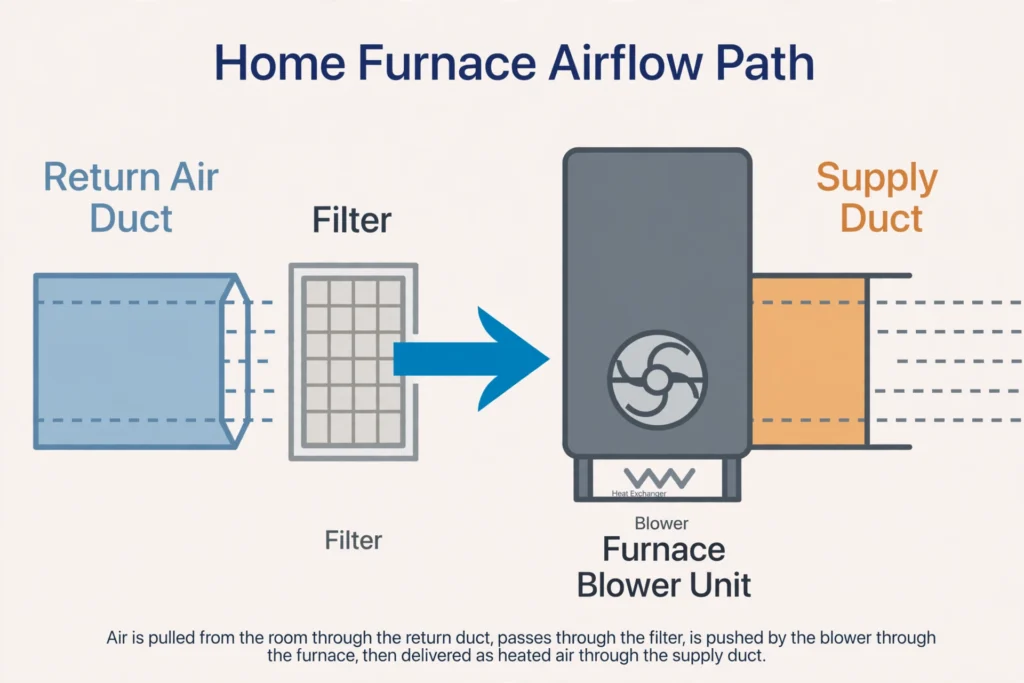
The airflow direction is always the same: room air travels through the return duct, passes through the filter, and enters the furnace blower. So the rule is simple — the arrow points toward the furnace.
How to Find Your Airflow Direction
If you’re staring at the filter slot and unsure which side is which, use these three checks:
- Look at the old filter first. Before you pull it out, note which way its arrow points. If it was installed correctly, just match it.
- Follow the ducts. The return duct is usually the larger of the two ducts at the filter slot — it carries air from your rooms toward the furnace. The supply duct runs from the furnace out to your vents. Air always flows return → furnace → supply.
- Think about it physically. Air gets pulled from your rooms, through the filter, and into the blower motor. The arrow points the way the air is traveling — into the furnace, never away from it.
What Happens If the Filter Is Backwards?
A backwards filter still catches some dust, but it filters less effectively because air hits the layers in the wrong order. The bigger concern is structural: the filter’s frame is designed to resist air pressure from one direction. Installed backwards, a flimsy filter can bend or collapse toward the blower, letting unfiltered air slip around it entirely — which defeats the purpose of having a filter at all.
What if my filter has no arrow on it?
Some basic filters — especially thin fiberglass ones — don’t print an arrow. Look for physical clues instead: the side with wire mesh or sturdier backing usually faces the furnace (the downstream side), while the softer media faces the incoming return air. When in doubt, check the filter’s packaging or the manufacturer’s instructions.
Does the arrow point up or down?
There’s no universal up or down — it depends on your system. In a typical upflow furnace, the arrow points up because air rises into the unit. In horizontal or downflow setups, it can point sideways or down. Follow the airflow, not the compass.
Can a backwards filter damage my furnace?
A backwards filter alone is unlikely to cause immediate damage. But poor filtration lets dust reach the blower and the heat exchanger or coils, and over time that buildup can reduce efficiency and lead to costly repairs. Correct installation is a two-minute job — worth getting right.
Swapping the filter is one of the easiest wins on our new homeowner maintenance checklist. For the full job, see our step-by-step guide: How to Change a Furnace Filter.