
The Complete New Homeowner Maintenance Checklist (The Owner’s Manual Your House Never Came With)
Congratulations — you own a home. Nobody handed you an owner’s manual for it, though. Cars come with one. Even toasters have troubleshooting guides. But a house, the most expensive thing you’ll ever buy, arrives with zero instructions and a quiet expectation that you’ll somehow just know what to do.
Here’s the truth: most expensive home repairs start as cheap, ignored maintenance tasks. A $15 furnace filter becomes a $5,000 blower motor replacement. A $10 tube of caulk becomes a $3,000 rot repair. A running toilet — which the EPA says can waste up to 200 gallons of water per day — becomes a shocking water bill.
This new homeowner maintenance checklist fixes that. It’s organized by how often each task needs doing — monthly, seasonal, and yearly — and every task includes the estimated time, cost, and skill level so you always know what you’re getting into. Follow it, and you’ll catch the small problems while they’re still small.
A note on safety: This guide covers maintenance, not repairs. If a task involves gas lines, your electrical panel, or anything on the roof, the answer is always “call a professional.” There’s a full “when to call a pro” section near the end — read it before you start anything you’re unsure about.
How to Use This New Homeowner Maintenance Checklist
Don’t try to do everything this weekend. The system is simple:
- Monthly tasks take 30–60 minutes total and keep the dangerous stuff (fire, carbon monoxide, water damage) in check.
- Seasonal tasks happen four times a year, timed to the weather — prep in fall, recover in spring.
- Yearly tasks are the deep checks you do once, ideally on the same date every year so you never forget.
Each task below is tagged with three things:
- ⏱ Time — how long it actually takes (not counting a trip to the hardware store)
- 💲 Cost — $0 if you already own basic tools, otherwise a rough ballpark (prices vary by region)
- 🛠 Skill — Beginner (anyone can do it), Intermediate (some comfort with tools required), or Call a Pro
Total time commitment: about 30–60 minutes per month for the monthly tasks, plus one focused weekend per season. That’s it. Your house will thank you.
First Things First: Learn Your House (Do This on Move-In Weekend)
Before any maintenance schedule matters, you need to know where things are. In an emergency — a burst pipe, a gas smell, a sparking outlet — you won’t have time to hunt. Spend one afternoon finding these:
1. The main water shut-off valve. Usually in the basement, crawlspace, garage, or near the water heater. Turn it gently to confirm it works (old valves can seize — if it won’t budge or it drips afterward, call a plumber; don’t force it). Label it with a tag or a piece of tape. Also find the shut-offs for the water heater and each toilet and sink — knowing these means a future leak becomes a 30-second fix instead of a flooded bathroom.
- ⏱ 20 min · 💲 $0 · 🛠 Beginner
2. The electrical panel (breaker box). Open it, read the labels, and fix the ones that are wrong or vague (“spare,” “???” — every panel has one). Flip each breaker off and on once to make sure none are stuck. Make sure everyone in the house knows where it is. Never open the panel cover itself — that’s electrician territory.
- ⏱ 20 min · 💲 $0 · 🛠 Beginner
3. The gas shut-off (if you have gas). Usually on the gas meter outside or where the line enters the house. You don’t need to touch it now — just know where it is and keep a wrench nearby. If you ever smell gas, leave the house and call the gas company from outside. Never troubleshoot gas yourself.
- ⏱ 10 min · 💲 $0 · 🛠 Beginner
4. The HVAC filter location. Pull the filter out and read the size printed on its frame (something like 16x25x1). Write it down — on your phone, on the filter slot, anywhere you’ll find it at the store. Buy two spares now so a future filter change takes five minutes instead of an errand.
- ⏱ 15 min · 💲 $10–30 (for spares) · 🛠 Beginner
5. The water heater. Read its label: fuel type, capacity, and — critically — the manufacture date. Water heaters typically last 8–12 years. If yours is pushing 10+, start budgeting for a replacement now rather than being surprised by a flooded utility room. Check the thermostat setting while you’re there (more on the right setting below).
- ⏱ 15 min · 💲 $0 · 🛠 Beginner
Your Monthly New Homeowner Maintenance Checklist
These five habits prevent the majority of home disasters. Put a recurring reminder on your phone for the first Saturday of the month.
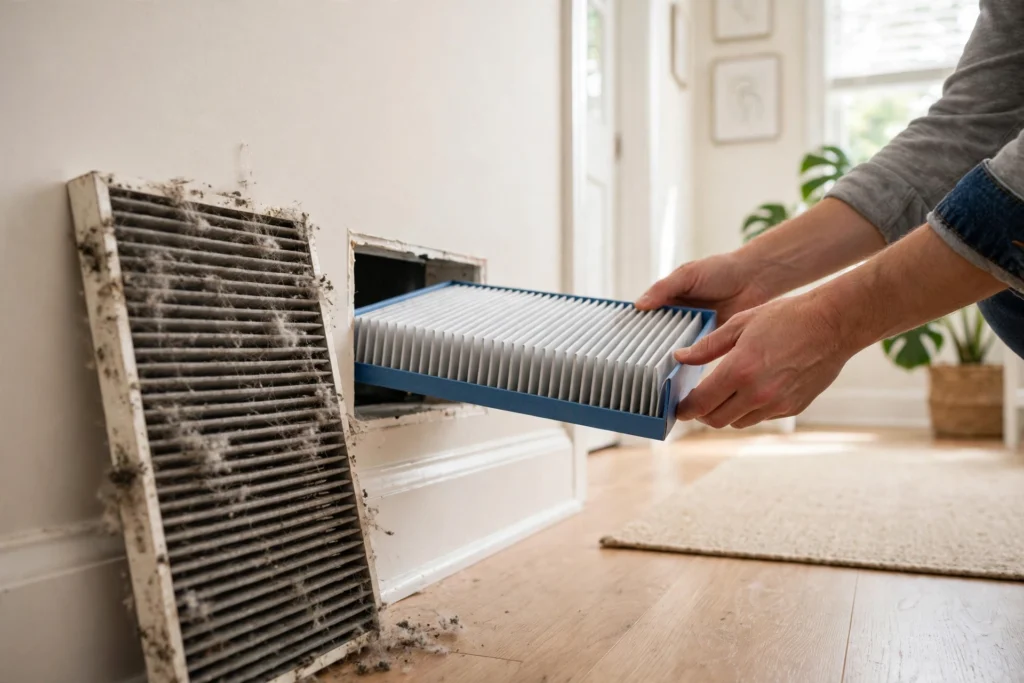
1. Check (and change if needed) the HVAC filter
A dirty filter chokes your heating and cooling system, raising energy bills and wearing out expensive parts. The U.S. Department of Energy advises checking your filter once a month and replacing it at least every three months. If you have pets, allergies, or run the system heavily, plan on every 30–60 days. The #1 beginner mistake is installing the new filter backward — there’s an arrow printed on the frame showing airflow direction. It must point toward the furnace/air handler, not away from it.
- ⏱ 5 min · 💲 $5–20 per filter · 🛠 Beginner
2. Test smoke and carbon monoxide detectors
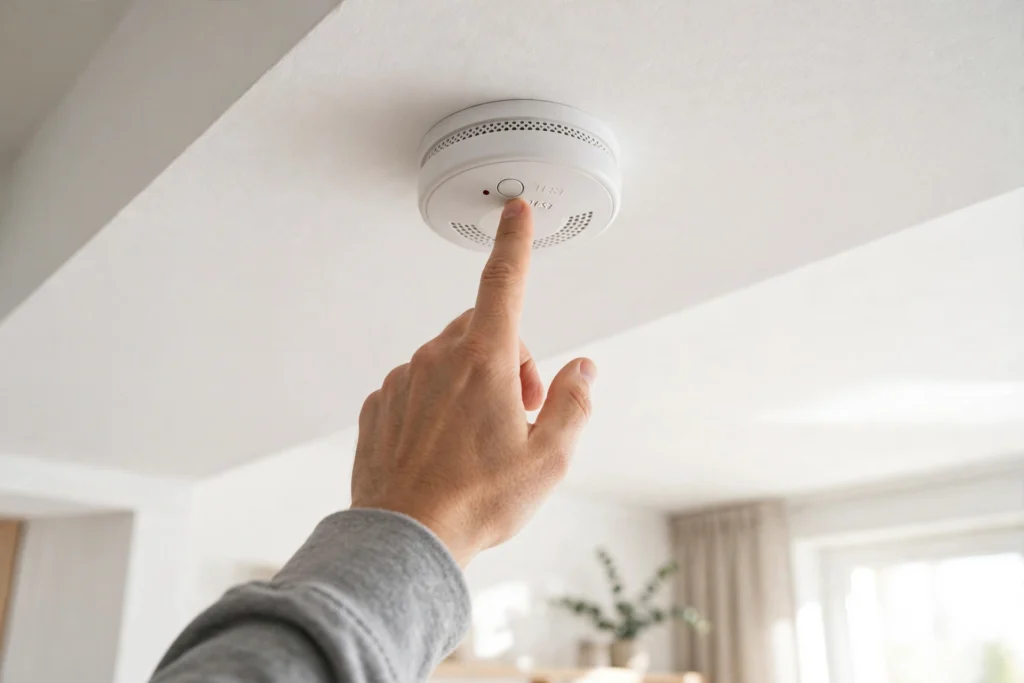
Press and hold the test button on every detector until it sounds. The National Fire Protection Association (NFPA) recommends testing monthly — it takes about ten minutes for a whole house, and it’s the highest-value safety habit you can build. If a detector chirps instead of sounding a full alarm, it needs a battery (or, if it has a sealed battery, it’s telling you something else — don’t ignore it).
- ⏱ 10 min · 💲 $0 · 🛠 Beginner
3. Walk the house looking for water
Water is the #1 enemy of houses, and it announces itself early if you look. Once a month, do a slow walk: look under every sink, around the base of each toilet, behind the washing machine, and around the water heater. Look for damp spots, warped cabinet bottoms, musty smells, or any dripping. Lift the toilet tank lid and listen — if you hear water running when nobody flushed, you have a silent leak (a running toilet can waste up to 200 gallons a day, per the EPA). Catching these early is the difference between a $10 flapper and a $1,000 subfloor repair.
- ⏱ 15 min · 💲 $0 · 🛠 Beginner
4. Glance at the fire extinguisher
You don’t need to do much — just look at the pressure gauge. If the needle is in the green zone, you’re good. If it’s in the red, replace or recharge it. Keep one in the kitchen and one near any fireplace or grill area, and make sure everyone knows where they are. A quick monthly glance means you’ll never discover a dead extinguisher during an actual emergency.
- ⏱ 2 min · 💲 $0 · 🛠 Beginner
5. Test GFCI outlets
Those outlets with the “Test” and “Reset” buttons (required in kitchens, bathrooms, garages, and outdoors) have a monthly test built in — press “Test,” the “Reset” button should pop out; press “Reset” to restore power. If the reset button won’t stay in, the outlet isn’t protecting you anymore and needs replacing (that’s a $15 part and a beginner-friendly job, or a quick electrician visit).
- ⏱ 5 min · 💲 $0 · 🛠 Beginner
Seasonal Maintenance for New Homeowners
Seasons change what your house needs. Do these in batches — one weekend per season covers all of them.
Spring: Recover and Prepare
Clean the gutters (first of two yearly cleanings). Clogged gutters dump water where it shouldn’t go — against your foundation, behind your siding, into your basement. Clean them in spring after the pollen and seed pods fall, and again in fall after the leaves. If you have heavy tree coverage, you may need a mid-summer check too. While you’re up there (or hiring someone), check that downspouts direct water at least several feet away from the foundation.
- ⏱ 1–2 hrs · 💲 $0 DIY / $100–300 pro · 🛠 Intermediate (ladder work) or Call a Pro
Service the air conditioner before you need it. Schedule an HVAC tune-up in spring so you’re not competing with everyone else during the first heat wave. A tech will clean the coils, check refrigerant levels, and catch worn parts. If you’d rather DIY the basics, at minimum hose off the outdoor condenser unit (power off first) and clear leaves and debris from around it.
- ⏱ 1 hr · 💲 $75–200 pro · 🛠 Beginner (basic cleaning) / Call a Pro (tune-up)
Inspect the roof from the ground. You don’t need to climb up — walk around with binoculars and look for missing, cracked, or curling shingles, and check the attic for daylight peeking through or water stains. Anything suspicious gets a roofer’s eyes, not yours.
- ⏱ 20 min · 💲 $0 · 🛠 Beginner
Turn outdoor faucets back on and check for freeze damage. Open each outdoor spigot and watch the wall inside (basement or crawlspace) for drips while it runs. A pipe that froze over winter may have cracked — and you’ll only discover it when you turn the water back on. Finding it now beats finding it as a flooded basement wall in July.
- ⏱ 15 min · 💲 $0 · 🛠 Beginner
Test the sump pump. Pour a bucket of water into the sump pit until the float rises — the pump should kick on and drain the pit. If your basement depends on this pump, this 5-minute test is the cheapest flood insurance you own. Consider a battery backup if you don’t have one (power outages and heavy storms love to arrive together).
- ⏱ 10 min · 💲 $0 · 🛠 Beginner
Summer: Heat, Pests, and Deep Cleans
Clean the dryer vent. This is the maintenance task most new homeowners have never heard of — and it’s a genuine fire hazard. The NFPA recommends professional dryer vent cleaning at least once a year, because lint buildup is a leading cause of clothes dryer fires (the U.S. Fire Administration reports roughly 2,900 dryer fires a year). Clean the lint trap before every load, and have the full vent run cleaned annually. If clothes are taking longer than usual to dry, that’s your vent telling you it’s overdue.
- ⏱ 1–2 hrs pro visit · 💲 $100–200 pro · 🛠 Call a Pro (or Intermediate with a vent-cleaning kit for short, straight vents)
Clean the refrigerator coils. Dusty condenser coils make your fridge work harder, run longer, and die sooner — and can raise its energy use noticeably. Clean them once or twice a year (twice if you have shedding pets). Unplug the fridge, find the coils (underneath behind a kick plate, or on the back), and vacuum them with a brush attachment. Don’t bend the fins.
- ⏱ 20 min · 💲 $0 · 🛠 Beginner
Check the attic and look for pests. Summer heat reveals problems: go up on a warm day and look for signs of roof leaks (stains on the underside of the roof deck), inadequate ventilation (it shouldn’t feel like a sauna with no airflow), and pest activity (droppings, chewed insulation, nests). Catching a wasp nest or a mouse entry point in July beats discovering it in November.
- ⏱ 30 min · 💲 $0 · 🛠 Beginner
Inspect decks, patios, and exterior wood. Look for soft or splintering boards, loose railings, and peeling stain or paint. Probe suspicious spots with a screwdriver — if it sinks in easily, you have rot starting. Small repairs now prevent full board or railing replacements later.
- ⏱ 30 min · 💲 $0–50 · 🛠 Beginner to Intermediate
Fall: Button Up Before Winter
Get the heating system serviced. Just like the AC in spring, have the furnace or heat pump professionally serviced in early fall — before the first cold snap creates a week-long waiting list. A technician checks the burners, heat exchanger, and safety controls. This is also when you discover that the “funny smell” from last winter was actually a cracked part, while there’s still time to fix it affordably.
- ⏱ 1 hr pro visit · 💲 $75–200 · 🛠 Call a Pro
Winterize outdoor faucets. This is the single highest-ROI fall task on this list. Disconnect all garden hoses (a connected hose is the #1 cause of burst outdoor spigots), shut off the indoor valve for each outdoor faucet if you have one, open the outside handle to drain remaining water, and add an insulated faucet cover for backup. A burst pipe inside a wall can cost thousands to repair; winterizing takes 30 minutes.
- ⏱ 30 min · 💲 $0–15 (faucet covers) · 🛠 Beginner
Clean the gutters (second yearly cleaning). Do this after most leaves have fallen but before the first hard freeze. Clogged gutters in winter cause ice dams — ridges of ice that force melting snow under your shingles and into your house. While you’re at it, make sure attic insulation isn’t blocking the soffit vents, since poor attic ventilation is the other half of the ice-dam equation.
- ⏱ 1–2 hrs · 💲 $0 DIY / $100–300 pro · 🛠 Intermediate or Call a Pro
Have the chimney inspected. NFPA standard 211 calls for chimneys, fireplaces, and vents to be inspected at least once a year — even ones you rarely use. Creosote buildup is highly flammable, and a chimney fire can spread to the house structure. Schedule it in late summer or early fall, before sweeps get booked solid.
- ⏱ 1 hr pro visit · 💲 $100–300 · 🛠 Call a Pro
Seal drafts. On a windy day, feel around windows and doors for air leaks. Replace worn weatherstripping, caulk gaps in window frames (exterior-grade caulk outside, paintable inside), and check that door sweeps make contact with the threshold. This is a cheap comfort upgrade that also trims heating bills.
- ⏱ 1–2 hrs · 💲 $20–60 in materials · 🛠 Beginner
Test detectors before heating season. Heating season means furnaces, fireplaces, and space heaters — all combustion sources. Press the test button on every smoke and CO detector, replace any batteries that are due, and confirm you have a CO detector on each level of the home, especially near sleeping areas.
- ⏱ 15 min · 💲 $0–30 (batteries) · 🛠 Beginner
Winter: Protect and Monitor
Keep the furnace filter fresh. Winter is peak season for your heating system, so check the filter monthly and don’t stretch the interval. A clogged filter in January can overheat the furnace and trip safety shutoffs — meaning no heat on the coldest night of the year.
- ⏱ 5 min · 💲 $5–20 · 🛠 Beginner
Prevent frozen pipes. When temperatures drop well below freezing, open cabinet doors under sinks on exterior walls so warm air reaches the pipes, and let faucets served by exposed pipes drip slightly during extreme cold snaps — moving water is much harder to freeze. If you leave town in winter, never set the thermostat below 55°F (13°C). Know where your main water shut-off is before you need it (you found it on move-in weekend — right?).
- ⏱ 10 min · 💲 $0 · 🛠 Beginner
Watch for ice dams. After heavy snow, look at your roofline from the ground. If you see thick ridges of ice at the eaves with icicles behind them, that’s an ice dam forming — melting snow is pooling behind the ice and can back up under shingles. Don’t climb up to chip at it (you’ll damage the shingles); use a roof rake from the ground to pull snow off the lower few feet of roof, and call a roofer if water starts coming in.
- ⏱ 20 min · 💲 $0–50 (roof rake) · 🛠 Beginner
Check for condensation and humidity issues. Winter seals houses up tight, and trapped moisture shows up as condensation on windows, musty closets, or mildew in bathrooms. Run bathroom exhaust fans during and after showers, and if windows are constantly foggy, your home may need better ventilation — a $20 humidity monitor (hygrometer) tells you where you stand. Aim for indoor humidity roughly between 30% and 50% in winter.
- ⏱ 10 min · 💲 $0–20 · 🛠 Beginner
Yearly Tasks (The Annual Deep Check)
Pick a date you’ll remember — the anniversary of your move-in, or the weekend you change the clocks — and work through these once a year.
Flush the water heater. Sediment builds up in every tank water heater, making it work harder, heat unevenly, and die sooner. Draining a few gallons from the tank’s drain valve once a year clears most of it. While you’re there: confirm the thermostat is set to 120°F (the U.S. Department of Energy’s recommended setting — hot enough for comfort, safer against scalds, and easier on energy bills), and test the temperature-pressure relief (TPR) valve by lifting its lever briefly — water should flow out and stop when you release it. If nothing comes out, or it keeps dripping afterward, call a plumber to replace the valve. Never cap or plug a TPR valve — it’s the tank’s critical safety device.
- ⏱ 30–45 min · 💲 $0 · 🛠 Beginner to Intermediate
Check the age of every smoke and CO detector. Look at the manufacture date printed on the back or side of each unit. Per NFPA 72, smoke alarms must be replaced at least 10 years from that date — not the purchase date, not the install date. Most people have no idea their alarms expired years ago. Carbon monoxide alarms have shorter lives — most are rated for 5 to 7 years — so check those dates too. When in doubt, replace: a $25 detector is the cheapest life insurance in your house.
- ⏱ 20 min · 💲 $0 to check / $20–40 per replacement · 🛠 Beginner
Deep-clean the dryer vent (if not done in summer). If you skipped the summer cleaning, do it now — but don’t skip the year. Lint is extremely flammable, and the vent run hides it where you can’t see it. This is one job worth hiring out annually unless you have a short, straight, easily accessible vent.
- ⏱ See summer section · 💲 $100–200 pro · 🛠 Call a Pro
Inspect the attic and crawlspace. Once a year, actually go into these spaces with a flashlight. Look for water stains, mold, chewed wiring or insulation, and daylight where there shouldn’t be any. Also walk the exterior foundation and look for new cracks or areas where soil has pulled away from the foundation — both can signal drainage problems worth addressing before they become foundation problems.
- ⏱ 45 min · 💲 $0 · 🛠 Beginner
Exercise the main water shut-off. Turn your main shut-off valve gently off and back on once a year. Valves that sit untouched for a decade tend to seize exactly when you need them most. If it’s already stuck, have a plumber free or replace it on your schedule — not at 2 AM during a leak.
- ⏱ 10 min · 💲 $0 · 🛠 Beginner
Clean refrigerator coils (if not done in summer). Same job, once or twice a year — pick the season you’ll actually remember and stick with it.
Review your homeowner’s insurance. Once a year, confirm your coverage still matches reality: renovations, new valuables, a finished basement, or a new roof all change what you should be insured for. Also confirm you know your deductible and have your agent’s number saved somewhere other than your memory.
- ⏱ 30 min · 💲 $0 · 🛠 Beginner
If you have a septic system: have it inspected and pumped on a professional’s recommended schedule — typically every 3 to 5 years for a household system. Write the last service date somewhere permanent. A failed septic system is a five-figure problem; pumping is a few hundred dollars.
- ⏱ Pro visit · 💲 $250–500 · 🛠 Call a Pro
When to Call a Professional (Read This Before You DIY Anything)
Part of being a good homeowner is knowing where your limits are. Call a pro — no exceptions, no YouTube bravery — for:
- Anything involving natural gas or propane. Smell gas? Leave the house, call the gas company from outside. No troubleshooting, ever.
- Work inside the electrical panel. Flipping a breaker is fine. Removing the panel cover, adding circuits, or touching bus bars is electrician-only. Electricity doesn’t give second chances.
- Active water leaks inside walls or ceilings. Shut off the water, then call a plumber. Opening walls to find a leak is a pro job — they have moisture meters and know where pipes run.
- Anything on the roof. Falls are the #1 cause of serious DIY injuries. A roofer with proper safety gear costs less than an ER visit.
- Chimney sweeping and inspection. Certified sweeps have the cameras and brushes to do it right, and your insurance may care that a pro did it.
- HVAC refrigerant, ductwork modifications, or anything involving the furnace’s combustion system. Filter changes: you. Everything else: a licensed tech.
- Large mold patches, structural cracks, or anything that smells like a bigger problem. If your gut says “this seems serious,” trust it and get an expert’s eyes on it.
A good rule of thumb: if the job requires a permit in your area, it requires a professional. When in doubt, get two quotes — reputable pros quote free.
Your Printable New Homeowner Maintenance Checklist
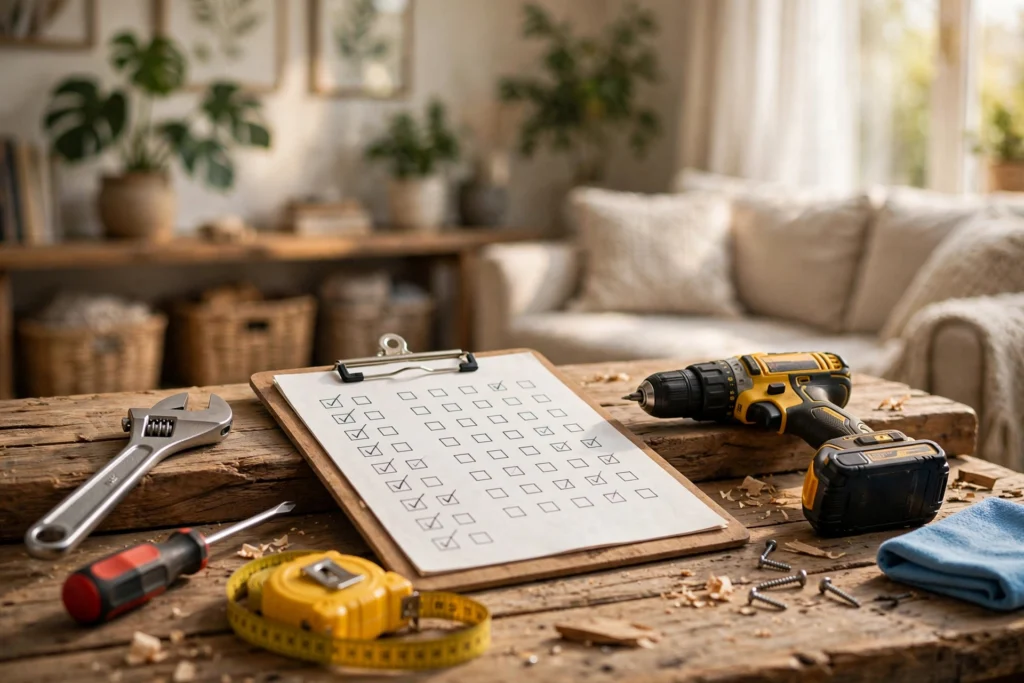
Copy this into your notes app or print it and stick it inside a utility closet door. Check items off as you go.
EVERY MONTH
– [ ] Check HVAC filter (replace every 1–3 months; monthly with pets/allergies)
– [ ] Test all smoke and CO detectors
– [ ] Walk the house: look under sinks, around toilets and water heater for leaks; listen for running toilets
– [ ] Glance at fire extinguisher gauge (green = good)
– [ ] Test GFCI outlets (Test → Reset)
SPRING
– [ ] Clean gutters
– [ ] Service the AC / clean the outdoor condenser unit
– [ ] Inspect roof from the ground; check attic for leaks
– [ ] Turn outdoor faucets back on; check for freeze damage
– [ ] Test the sump pump
SUMMER
– [ ] Clean the dryer vent (pro, at least once a year)
– [ ] Clean refrigerator coils
– [ ] Check attic for pests, moisture, and ventilation
– [ ] Inspect deck/patio/exterior wood for rot and loose railings
FALL
– [ ] Service the furnace/heat pump
– [ ] Winterize outdoor faucets (disconnect hoses, shut indoor valves, add covers)
– [ ] Clean gutters (after leaves fall, before first freeze)
– [ ] Chimney inspection (NFPA: at least once a year)
– [ ] Seal drafts: weatherstripping, caulk, door sweeps
– [ ] Test smoke and CO detectors before heating season
WINTER
– [ ] Check furnace filter monthly
– [ ] Prevent frozen pipes (cabinet doors open, drip faucets in extreme cold, heat at 55°F+ if away)
– [ ] Watch for ice dams after heavy snow
– [ ] Monitor indoor humidity (aim ~30–50%)
YEARLY
– [ ] Flush water heater sediment; confirm 120°F setting; test TPR valve
– [ ] Check manufacture dates on all smoke/CO detectors; replace any 10+ years old (smoke) or past rated life (CO)
– [ ] Inspect attic, crawlspace, and foundation
– [ ] Exercise the main water shut-off valve
– [ ] Review homeowner’s insurance coverage
– [ ] Septic: pump every 3–5 years (if applicable)
New Homeowner Maintenance FAQ
How often should I actually do home maintenance?
Think in rhythms, not one giant to-do list: about an hour a month for the quick checks (filters, detectors, leak walk-through), one weekend per season for the seasonal batch, and one deeper annual session. Most months, the whole routine takes less time than a grocery run.
What’s the single most important maintenance task for a new homeowner?
Two, actually, and they both protect lives, not just property: test your smoke and CO detectors monthly, and keep your HVAC filter clean. After that, the highest-value habit is the monthly water walk-through — catching leaks early saves more money than any other single habit on this list.
How much should I budget for home maintenance each year?
A widely cited rule of thumb is about 1% of your home’s value per year for maintenance (more for older homes, less for new construction). On a $300,000 home, that’s roughly $3,000 a year — but most of it is small, spread-out spending, not one big bill. The tasks in this checklist are overwhelmingly cheap or free; the budget mainly covers the pro visits (HVAC tune-ups, chimney inspection, dryer vent cleaning) and a reserve for the inevitable surprise.
Can I do all of this myself, or should I hire someone?
Most of this checklist is genuinely beginner-friendly — filters, detectors, gutters (from a ladder, carefully), caulking, and visual inspections. The pro jobs are: HVAC tune-ups, chimney inspection/sweeping, dryer vent cleaning (usually), and anything involving gas, the electrical panel, or the roof. When a task says “Call a Pro” above, it means it.
What should I check first right after moving in?
Find your main water shut-off, breaker panel, and gas shut-off. Check the manufacture dates on all smoke and CO detectors (replace anything expired). Read your HVAC filter size and buy spares. Note your water heater’s age and thermostat setting. That one afternoon covers your biggest risks.
How do I remember to do all of this?
Put recurring reminders on your phone: monthly (first Saturday), and seasonal triggers that match your climate — “service AC” in April, “winterize faucets” in October. Tie the yearly deep-check to something you won’t forget, like the day you change the clocks. The printable checklist above is designed to live on a closet door, not in a drawer.
The Bottom Line
Nobody is born knowing how to maintain a house — every experienced homeowner learned these tasks one at a time, usually right after something broke. This new homeowner maintenance checklist just lets you learn them before something breaks. Start with the move-in weekend basics, build the monthly habit, and work the seasons as they come. In a year, you’ll know your house better than most people ever know theirs — and your future self, the one not paying for emergency repairs, will be grateful.