
A GFCI outlet that keeps tripping is doing the job it was built for. A Ground Fault Circuit Interrupter watches for tiny leaks of electrical current — current escaping its intended path, potentially through a person — and shuts power off. The CPSC and ESFI credit GFCIs with protecting people from potentially lethal shock from ground faults. So a tripping GFCI is a symptom, not the disease: something on the circuit is leaking current, and the device is refusing to ignore it.
This guide gives you a safe five-step sequence — Identify → Isolate → Reset → Trace → Stop — using only checks that never require opening the outlet, touching wires, or using test equipment. You’ll also learn the trick most homeowners miss: a dead outlet without TEST/RESET buttons may be fed from a tripped GFCI in a different room. Diagnosis only — no outlet replacement, rewiring, or in-box work; that belongs to a licensed electrician.
⚠️ Stop immediately and call a licensed electrician — don’t keep resetting — if you notice any of these:
- A burning smell, or visible scorching, melting, or heat discoloration around the outlet
- Sparking from the outlet, or an outlet that feels unusually hot to the touch
- The GFCI trips again with everything unplugged
- The circuit breaker and the GFCI keep tripping together
- Obvious water intrusion affecting the outlet, its box, or nearby electrical equipment — never touch electrical equipment while wet or standing in water
- Anything that would require opening the outlet, its box, or the electrical panel to investigate
Repeatedly pressing RESET on a fault that keeps returning doesn’t fix anything — it just re-energizes a circuit that already told you something is wrong. (ESFI/CPSC: never bypass a safety device.)
GFCI vs. Breaker: Two Different Protectors That Trip for Different Reasons
Before diagnosing, confirm which protector is tripping — they respond to completely different problems. A circuit breaker protects your home’s wiring against overcurrent — overloads and short circuits that could overheat conductors (ESFI). A GFCI protects people against ground faults — minute current leaks that could pass through a person and cause shock (ESFI, in cooperation with the CPSC). The CPSC’s GFCI fact sheet credits standard breakers with no ground-fault or shock protection at all.
In plain terms: a breaker trips because too much current is flowing; a GFCI trips because current is flowing where it shouldn’t. Same symptom (no power), different cause, different diagnosis.
| What you see | Which protector tripped | What it’s reacting to | Safe next check | Stop condition |
|---|---|---|---|---|
| RESET button popped out on a GFCI receptacle | The GFCI (ground fault) | Current leaking to ground — shock risk | Unplug everything, press RESET once | Won’t reset, or trips again with nothing plugged in → electrician |
| Breaker handle sitting in the middle or OFF at the panel | The circuit breaker (overcurrent) | Too much current — wiring risk | Switch it fully OFF then ON once, using the external handle | Trips again → electrician; this guide doesn’t cover full breaker-tripping diagnosis |
| Both the breaker and the GFCI keep tripping | Both | Treat as a serious fault | None — stop | Call an electrician immediately |
| Dead outlet with no TEST/RESET buttons, nothing obvious at the panel | Possibly a tripped GFCI elsewhere | A downstream outlet (see below) lost protection power | Hunt for tripped GFCI receptacles in nearby bathrooms, garage, or outdoors | Can’t find or reset any → electrician |
One more place a GFCI can hide: the panel itself. GFCIs can be built into circuit breakers that protect an entire circuit (ESFI), so when you check the panel, look for breakers with their own TEST buttons too — a tripped GFCI breaker looks like a breaker problem but resets like a GFCI.
The 5-Step Diagnostic Sequence: Identify → Isolate → Reset → Trace → Stop
Here’s the whole framework at a glance. Work it top to bottom, and stop the moment a step tells you to.
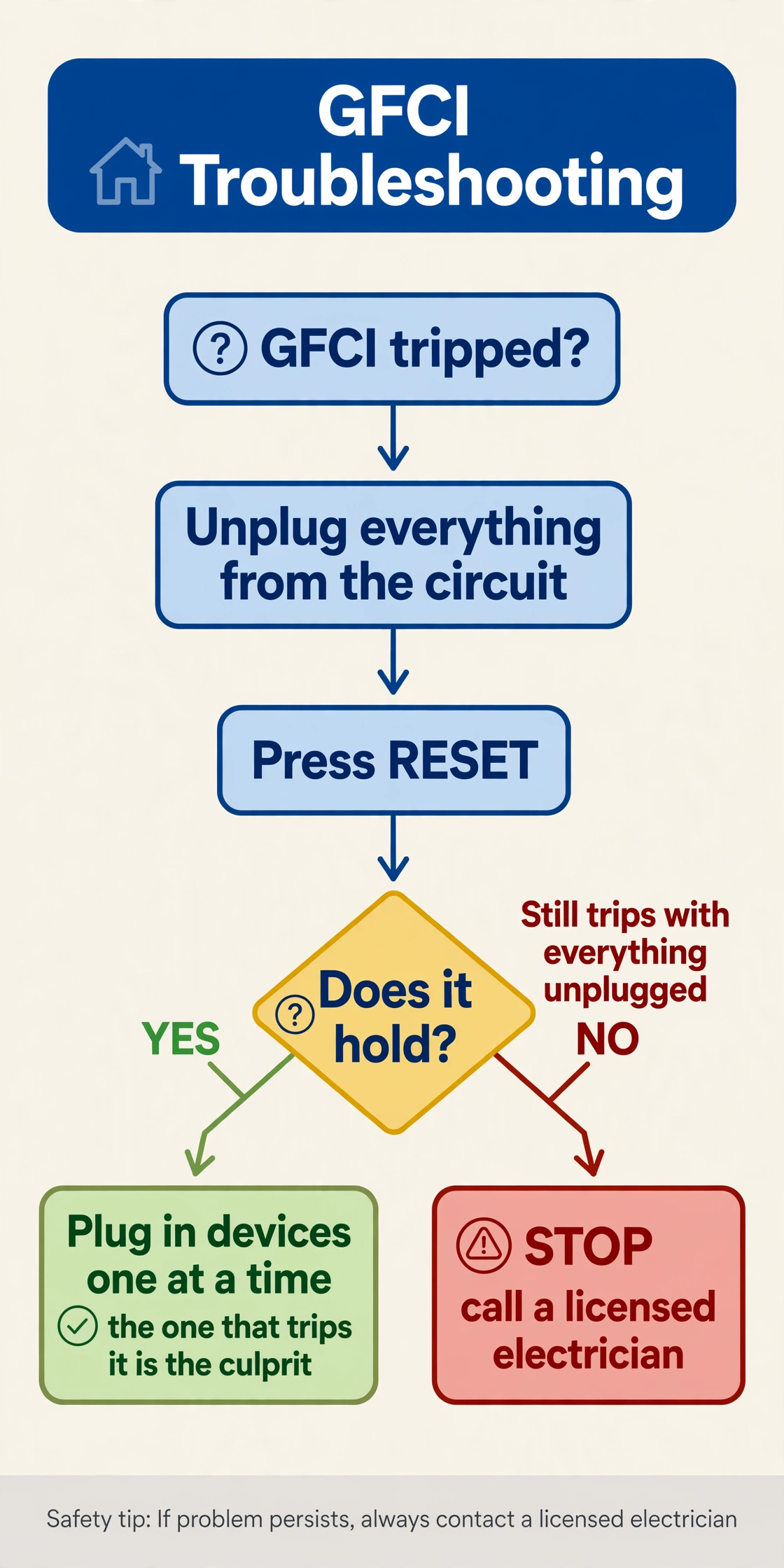
- Identify: Confirm what tripped — GFCI receptacle, GFCI breaker, standard breaker, or a dead downstream outlet.
- Isolate: Unplug every load so you’re testing the device, not your appliances.
- Reset: Attempt one normal reset and observe.
- Trace: If it holds, reconnect devices one at a time to find the culprit — or find a tripped GFCI elsewhere feeding a dead outlet.
- Stop: Hand off to a licensed electrician when the fault persists, moisture is involved, or anything looks or smells wrong.
Step 1 — Identify: Figure Out What Actually Tripped
Start at the misbehaving outlet. A GFCI receptacle has TEST and RESET buttons between its two outlets — that’s how you tell it apart from a standard receptacle.
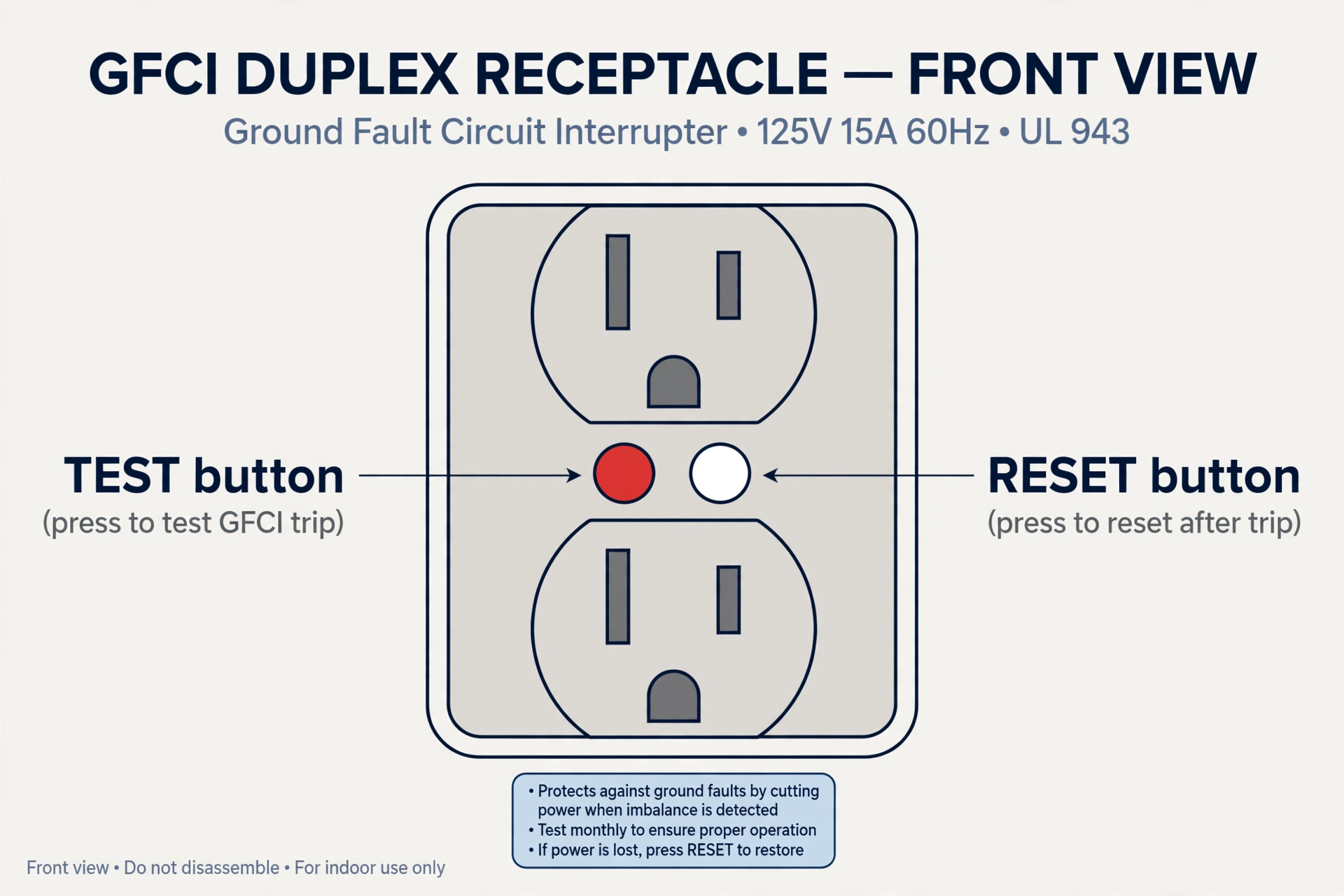
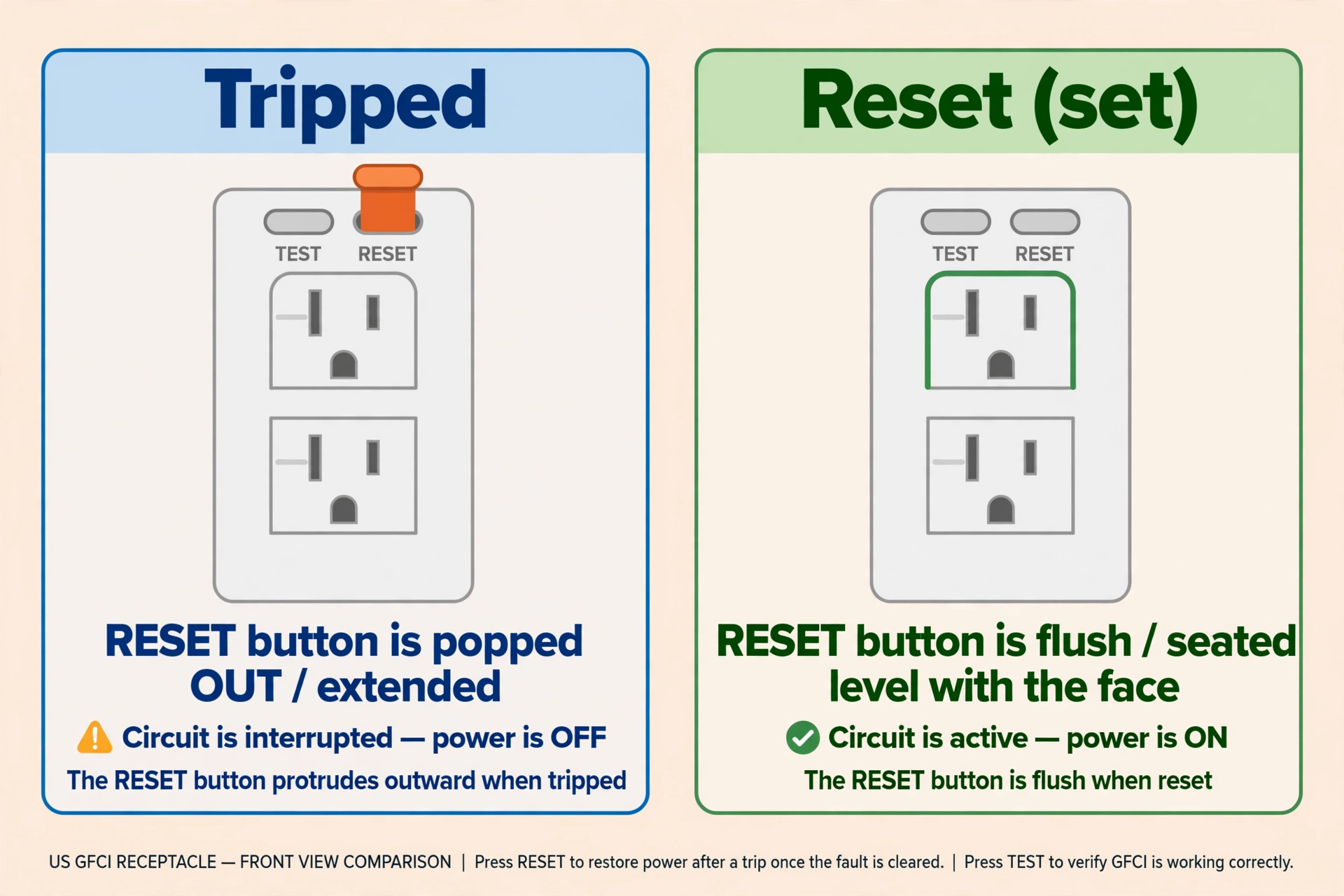
When a GFCI trips, the RESET button typically pops out — Eaton’s instructions note exactly that, and Leviton’s manuals describe the same convention; pressing RESET back in restores power. Modern models may use LED indicators instead, but those schemes are brand- and model-specific — there is no universal LED code, so don’t diagnose by LED color alone.
Now check these in order:
- Is the RESET button popped out on a GFCI receptacle? Then the GFCI tripped — move to Step 2.
- Is the outlet dead but has no TEST/RESET buttons? Don’t assume the outlet failed — it may sit downstream of a tripped GFCI in another room. See The Hidden Culprit: One GFCI Can Protect Other Outlets before doing anything else.
- Check the panel. Look for a breaker handle sitting between ON and OFF (or fully OFF) — and for any breaker with its own TEST button, which is a GFCI breaker protecting the whole circuit.
Step 2 — Isolate: Unplug Everything
A GFCI can’t tell you whether the ground fault is in an appliance or in the wiring — but you can narrow it down by removing every load and testing the device on its own.
- Unplug everything from the tripped GFCI — and from nearby outlets it might protect downstream. Power strips, chargers, everything: the circuit should be completely unloaded.
- Look, don’t touch internals. Inspect the outlet visually, without disassembly: scorch marks, melted or discolored plastic, cracks, or visible moisture around the outlet or cover. If you see any of these, stop here and call an electrician — do not press RESET.
Step 3 — Reset: Attempt One Normal Reset
With the circuit unloaded and the outlet visually clear, press RESET once, firmly, until it latches. (If your model resets differently, follow the device’s instructions.) What happens next is diagnostic information.
If it holds, the GFCI is likely fine and the fault was probably in something plugged in. Move to Step 4.
If RESET does nothing at all, check the panel first: some GFCIs physically cannot reset without power reaching the device (Leviton and Eaton both document this). A tripped breaker upstream means the GFCI has no power to reset with — you may reset a breaker once using its normal external handle (fully OFF, then ON), from outside the panel only. If the breaker won’t stay on, or the GFCI still won’t reset, stop and call an electrician.
If it trips again immediately with everything unplugged, stop. Don’t press RESET again — possible underlying causes include a fault at a downstream outlet, moisture intrusion, a wiring fault, or a GFCI at end of life, but the symptom alone doesn’t identify which, and none are resolvable from outside the box. Note “trips with everything unplugged” and call an electrician; that’s exactly the information they’ll want.
On “won’t reset”: modern lockout-type GFCIs intentionally refuse to reset when they can’t verify safe operation — a designed safety feature (Leviton), not a stuck button. Don’t force it.
Step 4 — Trace: Plug Devices Back In One at a Time
If the reset held with everything unplugged, find the culprit:
- Plug the first device back in and use it normally.
- If the GFCI holds, unplug it and try the next one. One at a time — patience is the whole technique.
- The device that consistently trips the GFCI is your culprit. Leave it unplugged and stop using it. Don’t move it to another outlet “just to see” — that’s the same faulty device on a different circuit, possibly one without GFCI protection. UL’s guidance: a suspect appliance should be checked for proper operation before reuse — by someone qualified, not by trial and error on your outlets.
- If the GFCI trips again after you’ve removed the suspect device, or if multiple unrelated devices each trip it, stop — that pattern points past any single appliance, toward moisture, a downstream fault, or the device itself.
Suspect first: aging small appliances with heating elements (space heaters, toasters, hair dryers), anything with a damaged cord, and weather-exposed outdoor or garage equipment.
The Hidden Culprit: One GFCI Can Protect Other Outlets
This is the single most useful thing most homeowners don’t know about GFCIs: one GFCI receptacle can protect additional ordinary outlets wired “downstream” from it. The CPSC’s GFCI fact sheet states that a receptacle-type GFCI protects against ground faults for whatever is plugged into it and other outlets further downstream in the branch circuit — Eaton’s installation sheets even have installers verify and label which surrounding receptacles lose power on TEST.
What that means: a dead outlet with no TEST/RESET buttons may not be broken — it may simply sit downstream of a tripped GFCI elsewhere in the house.
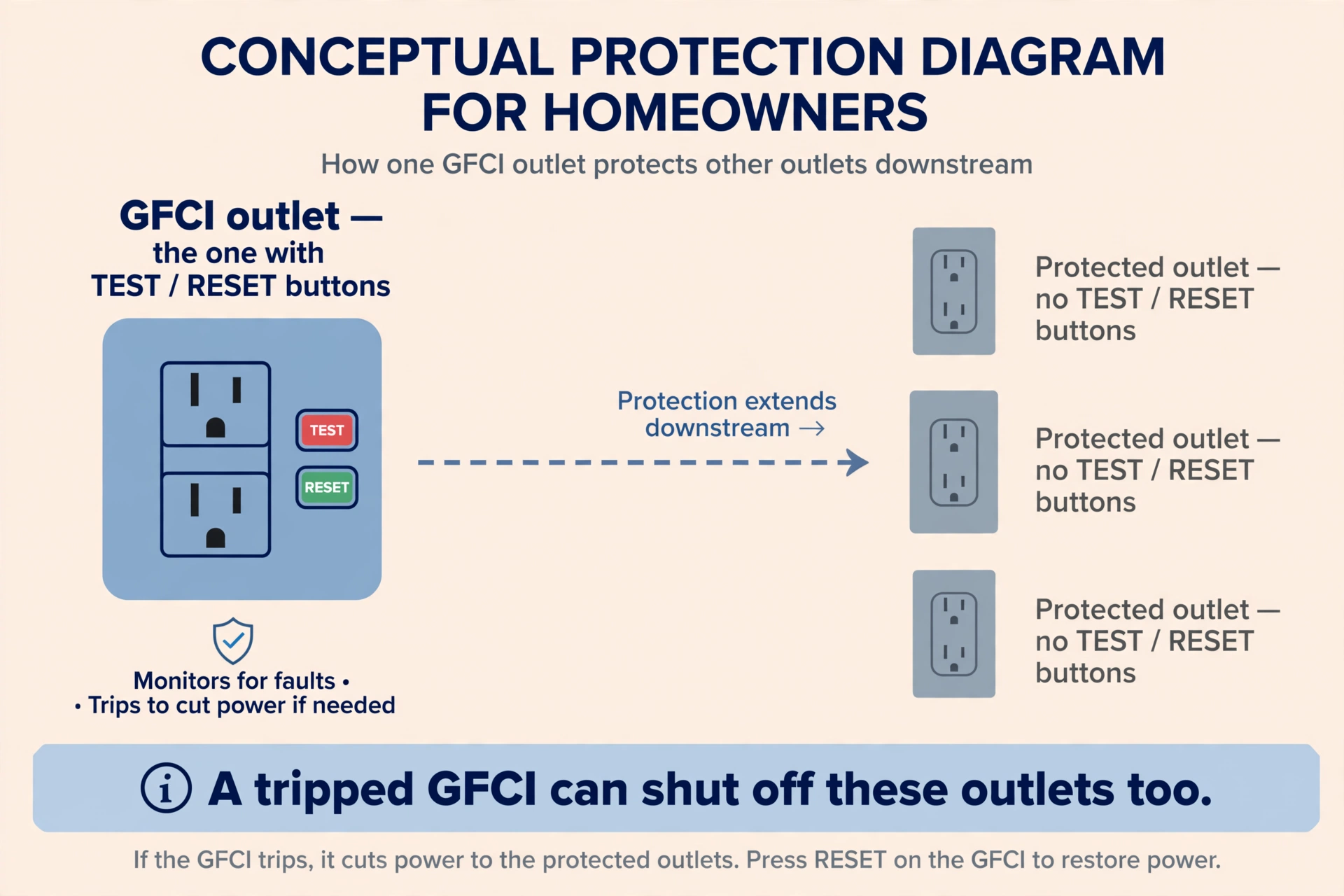
If you’re staring at a dead plain outlet:
- Think in zones, not rooms. The protecting GFCI is usually logically nearby — another bathroom, the garage, an exterior outlet, the basement, or the laundry area; bathrooms and garages are the most common hiding spots.
- Walk the zone. Look for any GFCI receptacle with its RESET button popped out (or its tripped indication per that model’s design).
- Reset it once and check whether your dead outlet came back to life. If it did, you’ve found the relationship — and where future trips will need resetting.
- If you can’t find a tripped GFCI, or resetting doesn’t restore the dead outlet, stop and call an electrician. Don’t open anything to investigate further.
When It Trips in Wet Conditions: The Moisture Branch
GFCIs are required exactly where water and electricity meet — bathrooms, kitchens, garages, laundry areas, and outdoors (per the National Electrical Code, via ESFI). Workplace safety guidance grounded in OSHA standards notes GFCIs can be “overly sensitive to moisture and humidity,” with occasional “nuisance tripping” on rainy or damp days.
But treat moisture as a safety branch, not a patience branch:
- If you can see water intrusion — a wet outlet or cover, water in or around the box, corrosion, or an outdoor GFCI that got soaked — stop using that equipment. Don’t repeatedly reset it, and don’t touch it while wet or while standing in water (ESFI/CPSC: never handle electrical items, plugs, or outlets when wet).
- Do not open the box or disassemble anything to “dry it out.” There are no safe improvised drying hacks for energized components, and no authoritative source endorses a “wait for it to dry” approach — Leviton’s own guidance notes that water exposure can mean replacement is necessary.
- Outdoor GFCIs should have weatherproof covers protecting them (ESFI/CPSC guidance: keep outlets covered, keep outdoor outlets weather-protected). A missing or broken cover plus rain is a classic setup for repeated trips — and for damage that only an electrician should assess.
- Bottom line for this branch: moisture + tripping = stop and call an electrician.
The TEST Button, Self-Tests, and End of Life
The TEST button isn’t a second reset button — it’s a built-in safety check that deliberately simulates a ground fault to verify the device trips and cuts power (CPSC); RESET then restores power. If TEST doesn’t cut power, the CPSC is unambiguous: the GFCI is not working or not correctly installed — contact a qualified electrician.
How often should you test? The floor across authoritative sources is monthly: the CPSC says test every GFCI at least once a month (plus after installation, after a power failure, and per the manufacturer’s instructions); Leviton and Eaton instruct monthly testing in their manuals; ESFI says monthly. UL adds one refinement: in sustained high heat (above 90°F) and high humidity (above 93% RH) — some bathrooms and indoor pool areas qualify — test more frequently. Monthly electrical checks fit naturally into a broader home-maintenance rhythm — our new-homeowner maintenance guide includes a seasonal checklist you can build them into.
Self-testing models from manufacturers including Leviton and Eaton periodically verify their own electronics automatically — a useful layer of assurance that doesn’t replace following the manufacturer’s testing guidance.
End of life is diagnosed by behavior, not by a calendar. No manufacturer or agency publishes a universal replacement age for GFCIs. What end of life looks like, per the manufacturers: Leviton documents a green LED as normal operation and a persistent red indicator (or a device that won’t reset) as end of life; Eaton states that a GFCI that has tripped and can no longer be reset has reached its “End of Life.” Replacement is consistently electrician work (UL, CPSC, ESFI) — which is exactly where this guide’s scope ends.
Why It Keeps Tripping: The Honest List of Causes
After working the sequence, the cause usually falls into one of these buckets:
- A faulty appliance or piece of equipment. The most common answer when one specific device consistently trips the GFCI. Damaged cords, aging heating elements, and weather-exposed tools are usual suspects.
- Moisture intrusion. Bathrooms, kitchens, garages, basements, laundry areas, outdoors — see the moisture branch; this escalates to an electrician.
- A downstream circuit issue. The fault is at a protected outlet beyond the GFCI itself — which is why the “hidden culprit” section matters.
- An aging or damaged GFCI device. Devices can and do fail; end-of-life behavior is covered above.
- A wiring or circuit fault. Damaged conductors, loose connections, or other faults inside the box or walls. Invisible from outside, diagnosable only with the box open — which is precisely why it’s electrician-only.
- A breaker-related issue, if the breaker is what’s tripping. Breakers trip on overload or short circuit, not ground faults — a tripping panel breaker is a different problem than this guide covers.
And the honest caveat: from outside the box, you cannot reliably distinguish a dying GFCI from a wiring fault from a moisture problem. The sequence rules out the simple, safe explanations (a bad appliance, a tripped protector elsewhere) and tells you exactly when the rest requires a professional.
When to Stop and Call an Electrician
Any of these ends the DIY portion of this guide — no exceptions, no “one more reset”:
- Burning smell, scorching, melting, or heat discoloration; sparking; an unusually hot outlet
- The GFCI trips with everything unplugged, or won’t reset at all
- The breaker and the GFCI keep tripping together
- Any sign of water intrusion around the outlet, box, or nearby electrical equipment
- Anything that would require opening the outlet, box, or panel — removing covers, touching conductors, tightening wires, or testing inside the box
- A TEST button that doesn’t cut power when pressed
When you call, tell them what tripped (GFCI receptacle, GFCI breaker, or standard breaker), whether it holds with everything unplugged, which device trips it if you found one, and whether moisture was involved. That summary saves diagnostic time and gets you a faster, cheaper answer.
Frequently Asked Questions
Why does my GFCI outlet keep tripping with nothing plugged in?
A trip with zero load means the fault isn’t in an appliance — it’s in the circuit, the device, or moisture: a fault at a downstream outlet, moisture intrusion, a wiring fault, or a GFCI at end of life. The symptom alone doesn’t identify which, and none are diagnosable without opening the box — so stop resetting and call a licensed electrician.
Why won’t my GFCI outlet reset?
The most common explanations: no power reaching the device (check whether the circuit breaker is tripped — some GFCIs physically cannot reset without power, per Leviton and Eaton), an upstream GFCI protecting it has tripped, or the device is detecting a persistent fault. Modern lockout-type GFCIs intentionally refuse to reset when they can’t verify safe operation — that’s a designed safety feature, not a stuck button. If the breaker is on and RESET still won’t latch, the device may be at end of life. Call an electrician; replacement is their work.
Can one GFCI outlet control other outlets?
Yes. A single GFCI receptacle can protect additional ordinary outlets wired downstream from it — the CPSC’s GFCI fact sheet confirms protection extends to outlets further downstream in the branch circuit. That’s why a dead outlet without TEST/RESET buttons is often just waiting on a tripped GFCI in a nearby bathroom, garage, or exterior wall. Walk the zone and check for a popped RESET button before assuming the dead outlet itself failed.
Why does my GFCI trip when it rains?
Moisture is a well-documented trip trigger — workplace safety guidance grounded in OSHA standards notes GFCIs can be sensitive to moisture and humidity, with occasional “nuisance tripping” on rainy or damp days. But treat this as a safety branch, not a patience branch: if an outdoor or garage GFCI is visibly wet, its cover is missing or broken, or you see corrosion, stop resetting it and call an electrician. Don’t touch wet electrical equipment, and don’t open the box to dry anything out — water exposure can compromise the device itself.
Is it safe to keep pressing RESET when it keeps tripping?
No. One normal reset after unplugging everything is a diagnostic step; repeated resetting against a persistent fault is not. UL treats a GFCI that trips repeatedly during normal use as a sign of a faulty appliance or a compromised GFCI — both point to replacement by a qualified electrician and a check of the appliance before reuse. If it trips again right away, stop and call an electrician.
What’s the difference between a GFCI trip and a breaker trip?
They react to different dangers. A GFCI trips on a ground fault — current leaking off its intended path (a shock hazard to people). A circuit breaker trips on overcurrent — an overload or short circuit (a fire hazard to wiring). (ESFI, in cooperation with the CPSC.) Different trips, different diagnoses: this guide covers GFCI tripping, not breaker tripping.
How often should I test my GFCI outlets?
At least once a month — the floor across the CPSC, Leviton, Eaton, and ESFI. (The CPSC adds: after installation, after a power failure, and per the manufacturer’s instructions.) UL advises more frequent testing in sustained hot (above 90°F) and humid (above 93% RH) environments. Press TEST to confirm power cuts, then RESET to restore it; if TEST doesn’t cut power, contact a qualified electrician (CPSC).
Do GFCI outlets wear out?
They can fail, but there’s no universal replacement age — no manufacturer or agency publishes a “replace every X years” rule. End of life is diagnosed by behavior: a device that fails its TEST check, won’t reset, shows a persistent red indicator (on models that use one — schemes vary), or trips repeatedly during normal use. Any of those means replacement by a qualified electrician, not a DIY swap.
Sources
- U.S. Consumer Product Safety Commission, GFCI Fact Sheet (Publication 099) — what GFCIs protect, TEST/RESET checks, monthly testing, when to contact a qualified electrician.
- ESFI (in cooperation with CPSC), Outdoor Electrical Safety Check booklet — GFCI vs. breaker roles, downstream protection, never bypass a safety device, never handle electrical items when wet.
- ESFI home-safety pages — GFCI function, monthly testing, replacement guidance, NEC-required locations.
- Leviton GFCI installation manuals (SmartLockPro GFTR2, GFNL1 self-test) — RESET behavior, power-required-to-reset, self-test, LED end-of-life indicators, lockout behavior.
- Leviton support article, “How to Reset a GFCI Outlet After Lockout” — reset sequence, lockout as safety feature, water-exposure replacement guidance.
- Eaton GFCI/AFCI installation instruction sheets — RESET pop-out on trip, power-required-to-reset, End of Life definition, downstream receptacle testing and labeling.
- UL published advice on GFCIs — monthly testing (more often above 90°F / 93% RH), replacement by a qualified electrician when TEST fails, RESET fails, or trips repeat during normal use.
- OSHA-based workplace safety guidance (Safety Matters Weekly) — GFCI moisture/humidity sensitivity and “nuisance tripping” on rainy or damp days.
This guide is for diagnosis only and doesn’t replace professional electrical work. When in doubt — or whenever a stop condition above applies — call a licensed electrician.

Mohammed Algaari is the founder and editor of DIYMendly, a practical home-repair resource focused on making common DIY problems easier to understand and solve. He oversees the site’s content strategy and editorial direction, with an emphasis on clear, well-researched, step-by-step guidance based on reliable sources.