
You flip the switch and instead of the usual grind you get a low, steady hum — and nothing moves. Before you do anything else, read this: turn the disposal OFF right now. A humming disposal is a stalled motor, and a stalled motor overheats. And never, ever put your hand down the drain — not even “just to feel what’s in there.”
The good news: a hum almost always means the disposal is jammed, not dead. A jammed flywheel can usually be freed in about 10 minutes with a simple hex wrench. Here’s how to diagnose the sound and fix it safely.
Quick answer: If your garbage disposal hums but won’t spin, turn it OFF immediately — a stalled motor overheats, and never put your hand inside the drain. The flywheel is usually jammed by food or an object. With the power off, free it using the hex wrench in the bottom socket, remove the debris with tongs, then press the red reset button.
⏱ 10–15 min · 💲 $0 (you likely own the tools) · 🛠 Beginner
What you’ll need:
- 1/4-inch hex (Allen) wrench — many disposals actually came with one; check the cabinet
- Tongs or needle-nose pliers — for pulling out debris
- Flashlight
- Bucket and towel
Don’t have a hex wrench set yet? Our essential DIY tools guide covers the basics every homeowner should own.
Safety first — non-negotiable: Never put your hand or fingers inside the disposal, even when it’s off. Use tongs or pliers for everything. Work with the wall switch OFF, and unplug the unit (or switch off the breaker) before reaching in with any tool.
Step 1: Diagnose the Sound
Different sounds mean different problems. Match yours:
| Sound | What it means | Your move |
|---|---|---|
| Steady hum, no spinning | Flywheel is jammed (food, bone fragment, utensil) | Unjam it — Steps 2–4 below |
| Complete silence, nothing happens | No power — tripped GFCI, tripped breaker, or dead unit | Step 5: check power |
| Loud grinding or rattling | Hard object bouncing around inside (bottle cap, twist tie, bone) | Power off, fish it out with tongs |
| Hum that stops after a few seconds | Motor overheated and tripped its thermal protector | Wait 5–10 minutes to cool, then press the reset button |
The hum is actually good news — it means the motor is getting power and trying to work. Silence is the one that might mean a dead unit.
Step 2: Cut the Power Completely
- Turn the wall switch OFF.
- Unplug the disposal from the outlet under the sink. (If it’s hardwired with no plug, switch off the breaker for the disposal circuit instead — and tape the switch off so nobody flips it.)
- Shine the flashlight down the drain and look for the obstruction. Don’t reach in.
Step 3: Free the Flywheel with the Hex Wrench
Underneath the disposal, in the center of the bottom, there’s a small hexagonal socket. This is the manual flywheel crank — it exists exactly for this situation.
- Insert a 1/4-inch hex (Allen) wrench into the bottom socket.
- Work it back and forth — don’t just push one direction. You’re rocking the flywheel loose from whatever is wedging it.
- You’ll feel resistance, then a sudden release as the jam breaks free. Keep working it until the wrench turns freely in both directions.
Don’t have the hex socket? Most InSinkErator models have it, but some Waste King and other models don’t. If there’s no socket: with the power still OFF, use tongs from above to grip the grinding plate and work it back and forth. Never use your fingers.
If the flywheel won’t budge at all after a minute of working it, stop — something may be seriously wedged or the bearings may be seized. That’s a replacement situation (see below), not a force-it situation.
Step 4: Remove the Debris and Hit Reset
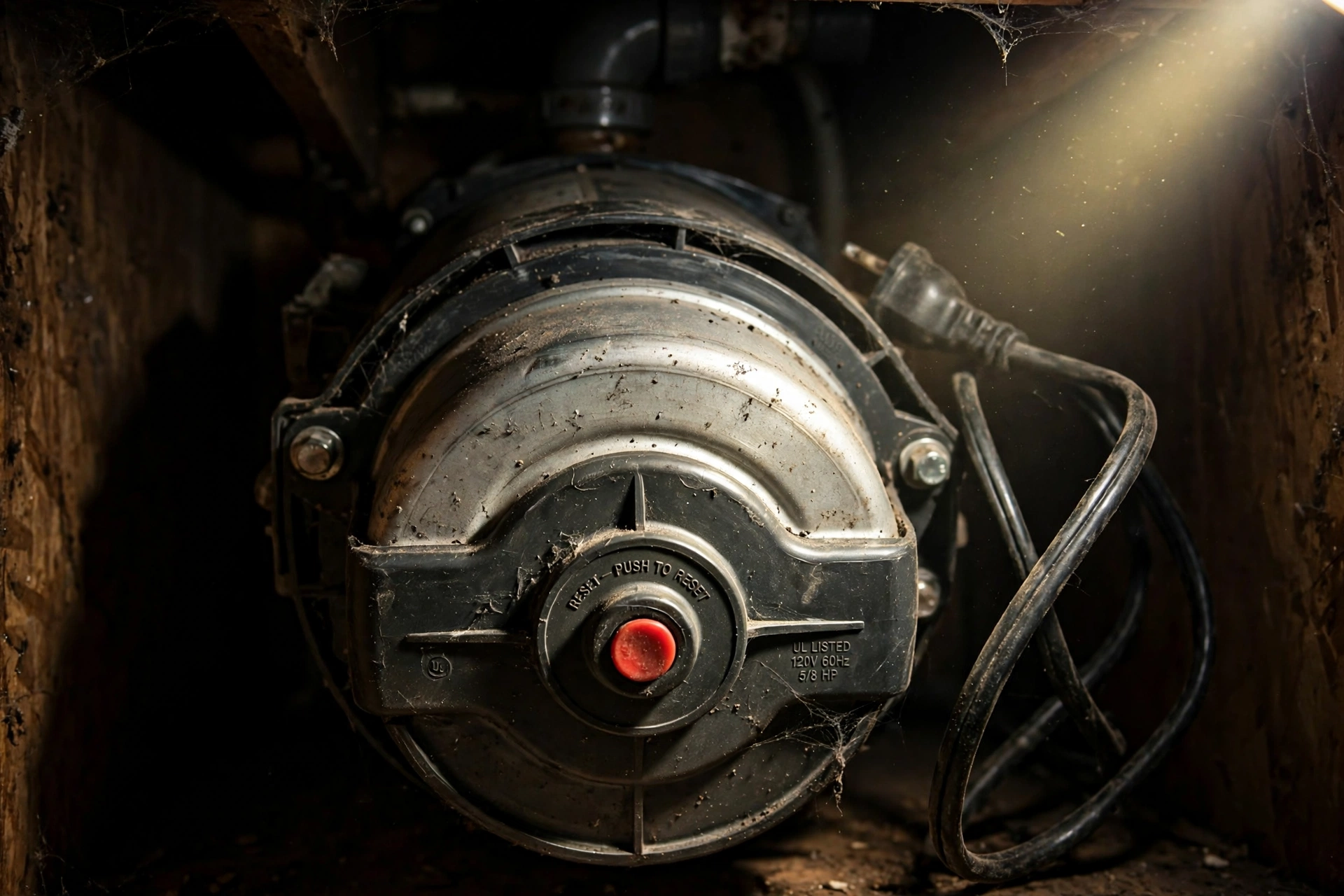
- With the power still OFF, use tongs or needle-nose pliers to pull out whatever was jamming it — the usual suspects are bone fragments, fruit pits, bottle caps, and twist ties.
- Now find the red reset button on the bottom (or side) of the disposal. If the motor overheated during the jam, this button will have popped out.
- Wait a few minutes for the motor to cool if it was humming for a while, then press the reset button firmly until it clicks and stays in.
- Restore power (plug in / breaker on), run cold water, and flip the switch. It should spin up normally.
Step 5: If There’s No Power at All (Silence)
Work through these in order:
- Press the red reset button on the disposal itself.
- Check the GFCI outlet under the sink — disposals are often on a GFCI circuit. If the outlet’s “reset” button has popped, press it.
- Check the breaker panel — flip the disposal’s breaker fully off, then back on.
- Test the outlet with another device (a phone charger works) to confirm the outlet itself has power.
If the outlet has power, the reset is in, and the disposal is still completely silent — the motor is likely dead. See “when the motor is actually dead” below.
Prevention: Keep It From Jamming Again
- Always run cold water before, during, and for 15–30 seconds after using the disposal. Cold water keeps fats solid so they flush through instead of coating the pipes.
- Feed waste gradually, not in big dumps.
- No grease, oil, or fat — they solidify in pipes and cause clogs downstream.
- No fibrous foods (celery, corn husks, onion skins, artichokes) — the fibers wrap around the flywheel.
- No bones, pits, or shells — they’re harder than the grinding components are designed for.
- No non-food items, obviously — but check for twist ties and bottle caps that fall in unnoticed.
- Grind a tray of ice cubes occasionally — it scours the grinding chamber. (Citrus peels freshen the smell, but they don’t clean anything mechanically.)
When the Motor Is Actually Dead: Repair or Replace?
Be honest with yourself if:
- The reset button trips again immediately, every time
- You smell burning or see smoke
- The unit is 8–12+ years old and has needed frequent resets
- The flywheel is seized solid and won’t move with the hex wrench
- Water leaks from the disposal body itself (not a connection — the housing)
A disposal isn’t really a repairable appliance — there are no user-serviceable parts inside the motor housing. Replacement is the standard fix. A basic replacement unit typically costs in the low hundreds of dollars (prices vary by brand and power), and swapping one is a moderate DIY job — or a straightforward, usually affordable plumber visit if you’d rather not deal with the wiring and mounting.
If the unit is still under warranty, check that first — many carry multi-year warranties.
FAQ
Why is my garbage disposal humming and not spinning?
The flywheel is jammed — usually by food waste, a bone fragment, or a small object wedged between the plate and the grinding ring. The motor hums because it’s powered but can’t turn. Free the flywheel with the hex wrench (power off), remove the debris, and press the reset button.
Where is the reset button on a garbage disposal?
On the bottom of the unit (occasionally on the side) — a small red or black button. If the motor overheated, it pops out; press it firmly back in after letting the motor cool for a few minutes.
Can I use my hand to check what’s stuck in the disposal?
No. Never put your hand or fingers inside a garbage disposal, even with the power off. Use tongs or pliers. The grinding components are sharp and the flywheel can shift unexpectedly.
My disposal is completely silent — is it dead?
Not necessarily. Check the reset button, the GFCI outlet under the sink, and the breaker first. Silence with good power and a set reset button is the real sign of a dead motor.
How long should a garbage disposal last?
Most last around 8–12 years depending on use and model, though some go longer. Frequent jams, persistent odors, and repeated resets are signs yours is near the end.
When to Call a Pro — No Exceptions
- Any electrical work beyond the GFCI and breaker — if the outlet is dead and the breaker is fine, that’s an electrician’s job.
- Water leaking from the disposal housing itself (cracked body) — replace the unit; don’t try to seal it.
- You’re not comfortable with the unplug/breaker steps — there’s no shame in calling for help with anything involving electricity and water in the same cabinet.
- The disposal is hardwired and you need to replace it — if you’re not confident working with wire connections, have a pro do the swap.
The Bottom Line
A humming disposal is almost always a jam, not a death sentence: power off, hex wrench in the bottom socket, work the flywheel free, pull the debris with tongs, press the red reset button. Ten minutes, zero dollars, and you’re back in business. Save the replacement money for when the motor truly gives up.