
You turn off the faucet — bang. The washing machine finishes filling — bang. Somewhere inside the wall, your pipes sound like they’re being hit with a hammer. That sound has a name — water hammer — but not every banging pipe is water hammer, and treating the wrong cause wastes time and money. This guide gives you a diagnostic framework: figure out exactly when the bang happens, run simple isolation tests, and land on the most plausible cause — plus a clear line between what you can safely do yourself and what belongs to a plumber.
Scope of this guide: diagnosis of banging/knocking in pressurized supply pipes, plus homeowner-safe checks and fixes. It does not cover drain gurgling, sewer venting, heating-system pipes, or any work inside walls. Procedures like soldering, opening concealed plumbing, and adjusting a pressure regulator are professional-only — this guide marks exactly where the DIY road ends.
Quick Answer
If your pipes produce a single loud bang the instant you shut off a faucet — or when the washing machine, dishwasher, or toilet fill valve snaps shut — the most likely explanation is water hammer: the moving column of water stops suddenly, and the resulting pressure shockwave rattles the pipes. The single most useful triage question is timing plus trigger: does the bang happen exactly at shutoff, and which fixture or appliance causes it? A bang that happens while water is running, or a ticking that follows hot water, usually points to a different mechanism — the sections below help you tell them apart.
Stop First: When Banging Means Call a Plumber Now
Before diagnosing anything, check for these. If any apply, skip the tests and call a qualified plumber:
- You can see water leaking from a pipe, joint, or fixture — an active leak outranks any diagnosis.
- Banging is accompanied by a sudden loss of water pressure or no water at all — something may have broken or burst.
- A water stain on a ceiling or wall is spreading while the banging happens — water is going where it shouldn’t.
- The banging started suddenly across the whole house along with other pressure symptoms (faucets blasting, toilets running on their own) — the household pressure may be far too high.
- Any fix would require opening a wall, soldering, or touching the pressure regulator — those are professional-only by definition, not a DIY challenge.
None of those apply? Good — continue. The rest of this guide walks you through narrowing it down safely.
What Water Hammer Actually Is: The 60-Second Version
Water is effectively incompressible, and a column of water moving through your pipes carries real momentum. When a valve closes suddenly, that moving water has nowhere to go — its kinetic energy converts into a pressure spike, and a shockwave races through the piping at roughly the speed of sound in water (over 4,800 feet per second, per the American Society of Plumbing Engineers). The wave bounces back and forth until the energy dissipates, and each pass can slam pipes against framing. That is the bang.
Two design details complete the picture. First, plumbing systems include cushions — air chambers (simple vertical capped pipe sections) or mechanical water hammer arresters (sealed units with a piston or air bladder) — whose job is to absorb the shock so the pipes don’t have to. Second, the faster a valve closes, the bigger the shock: a slowly turned gate valve barely registers, while the solenoid valves in washing machines and dishwashers snap shut almost instantly. That is why appliances are the classic triggers.

Not Every Bang Is Water Hammer
This is the step most guides skip — and the one that matters most. A bang is a clue, not a diagnosis: identical-sounding knocks can come from different mechanisms, and each one wants a different fix. Work through this comparison before you decide what you’re hearing.
| What you hear | When it happens | Most likely mechanism |
|---|---|---|
| One sharp bang, then silence | Exactly when a faucet or appliance valve shuts | True water hammer |
| Rattling or banging that seems to come from inside a wall or floor | With any flow change; louder in some spots | Loose, unsecured pipes amplifying the shock |
| Rapid machine-gun banging — bang-bang-bang | While water is running through one valve | Worn washer fluttering inside the valve |
| Ticking or tapping, mostly on hot-water lines | While hot water runs, fading as pipes cool | Thermal expansion — copper expanding and rubbing against framing |
| Bangs at many fixtures, plus unusually forceful flow | At shutoff, all over the house | High household water pressure intensifying every shock |
| Gurgling or bubbling | From drains, when the toilet flushes | A drain-system issue, not supply pipes — different guide entirely |
The key distinction: true water hammer is tied to a flow stopping. Knocking that happens while water flows, or ticking that follows hot water through the pipes, is almost certainly something else.
The Isolation Tests
You don’t need tools for this — just your ears, your eyes, and a few minutes. Run each test and write down what happens. The router table in the next section does the rest.
Test 1: Find the trigger
Open each faucet in the house one at a time, let it run for a few seconds, then close it the way you normally would. Note which ones produce a bang. Then run the washing machine, dishwasher, and each toilet through a fill cycle and listen for the bang when each one stops filling. The trigger list is the single most informative thing you can hand a plumber.
Test 2: Hot vs. cold
At a faucet that bangs, run hot only, then cold only, then both. A bang on one side only narrows the search to that supply line; a bang on both suggests the cause is further upstream. Ticking that appears only on the hot side while water runs points toward thermal expansion rather than water hammer.
Test 3: One fixture vs. the whole house
Is the bang confined to one bathroom, or does it happen at fixtures all over the house? One fixture points local (that valve, that branch); whole-house banging points systemic (pressure, or a cushion problem affecting the entire system).
Test 4: Faucets vs. appliances
Faucets — even single-lever ones — close at human speed. Appliance solenoid valves close in a fraction of a second. If the bang happens only when the washer or dishwasher cycles, you’re almost certainly looking at appliance valve shock, which has its own fix path.
Test 5: Timing and repetition
Listen carefully to the rhythm. A single bang exactly at shutoff is the classic water-hammer signature. Repeated banging after shutoff means the shockwave is bouncing through loose or long pipe runs. Continuous rapid banging while water flows is the worn-washer pattern, not water hammer at all.
Test 6: Look at accessible pipes
In a basement, crawlspace, or utility room, watch the visible pipes while someone triggers the bang upstairs. Pipes that visibly jump or rattle are telling you they’re loose — the shock may be real, but unsecured pipework is doing the amplifying.
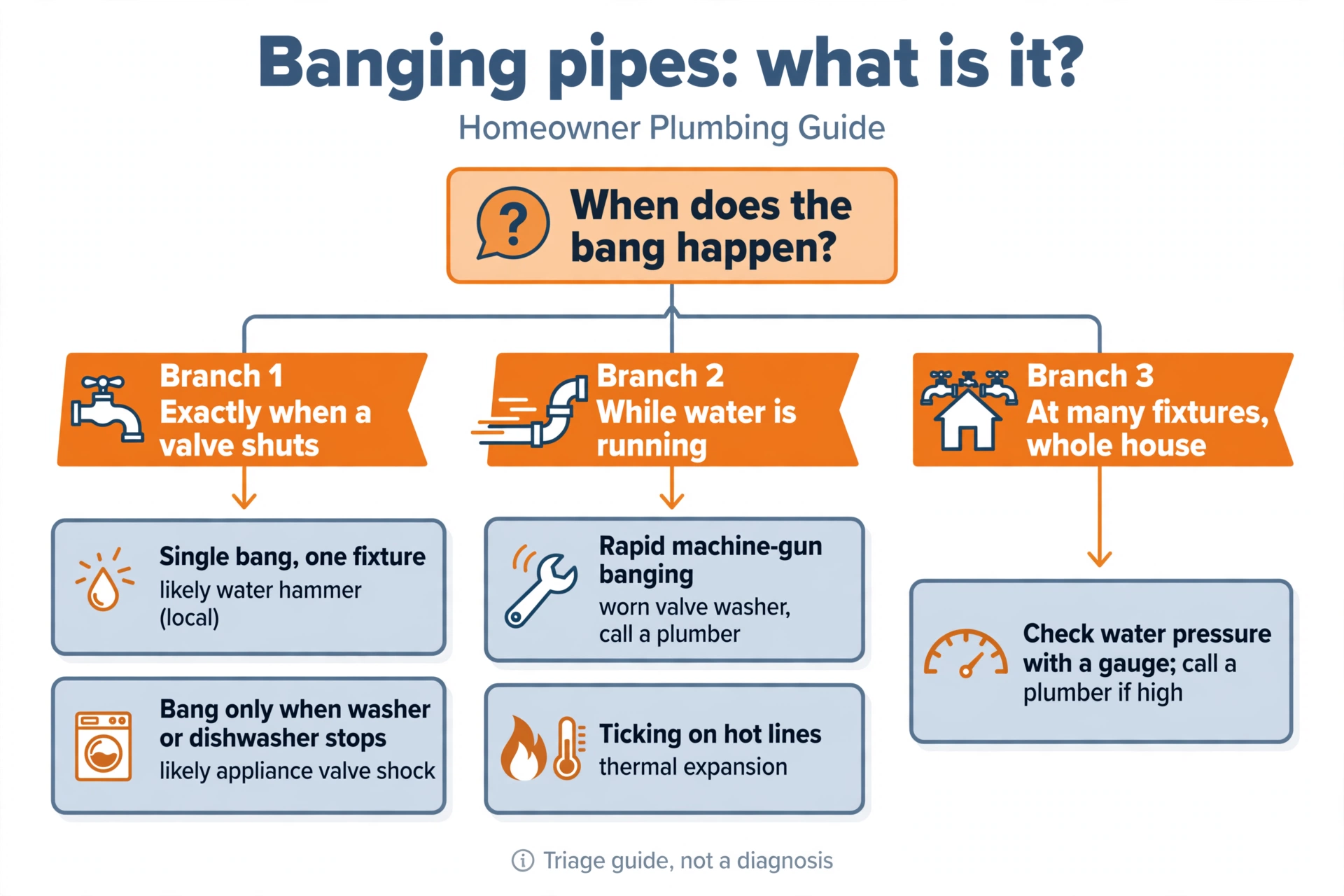
The Router: Pattern → Most Plausible Cause → Next Move
| What you observe | Most plausible cause | Next move |
|---|---|---|
| Single bang exactly at shutoff, one faucet | True water hammer, local to that branch | Safe checks below; slow-close habit; assess that branch |
| Bang only when the washer or dishwasher stops filling | Appliance solenoid valve shock | Arrester at the appliance (pro consult for sizing/placement); check household pressure |
| Rapid bang-bang-bang while water runs | Worn washer fluttering in the valve | Plumber — valve repair, not a hammer fix |
| Ticking/tapping on hot lines while water runs | Thermal expansion rubbing against framing | Monitor; plumber if loud, persistent, or worsening |
| Bangs at many fixtures across the house | High water pressure, or system-wide cushion failure | Check pressure with a gauge (below); plumber if high |
| Bang started right after plumbing work | Disturbed strapping, drained air chambers, or a new quick-closing valve | Call back the installer, or a plumber if it persists |
| Visible pipe movement with the bang | Loose, unsecured pipes | Secure accessible runs; concealed runs are a plumber’s job |
Every “most plausible” above is a triage suggestion, not a diagnosis. A plumber with eyes on the actual pipes confirms it.
The Cause Branches, Explained
Fast-Closing Valves (Including Appliance Solenoids)
How it fits the router: the single-bang-at-shutoff pattern, especially with appliances. Modern washing machines, dishwashers, ice makers, and many toilet fill valves use solenoid valves that close nearly instantly — going, as one plumbing supplier’s technical expert puts it, from full flow to zero in no time flat. No cushion in the line means the full shock hits the piping.
What it looks like: the bang is tightly coupled to one appliance’s cycle — you hear it the moment the washer stops filling, every time. Faucets may be quiet while appliances bang.
What not to assume: don’t assume the appliance is broken. The valve is doing what it was designed to do; the system lacks the cushion the code expects. Plumbing codes (UPC 604.9 / 609.10) require water-hammer arresters where quick-closing valves are installed, placed as close as possible to those valves — which tells you this is a known, designed-for problem, not a mystery.
Waterlogged Air Chambers
How it fits the router: banging that developed gradually in an older home, at fixtures that used to be quiet. Many older systems have simple air chambers — vertical capped pipe sections near fixtures that trap a pocket of air as a cushion. Over time, that air dissolves into the water, the chamber fills, and the cushion disappears.
What it looks like: a slow onset — quiet for years, then banging that gets more frequent. Often affects fixtures near the old chambers first.
What not to assume: don’t assume draining and refilling the system is a permanent cure. It can restore the air pocket (more below), but the air will dissolve again over time. Mechanical arresters exist precisely because plain air chambers are a temporary cushion.
High Household Water Pressure
How it fits the router: the whole-house row — bangs at many fixtures, unusually forceful flow, maybe toilets that run or fill valves that chatter. Higher baseline pressure means every valve closure hits harder.
What it looks like: everything is louder and more forceful than it should be. The residential plumbing code caps static pressure at 80 psi (IRC P2903.3.1) and requires a pressure-reducing valve (PRV) where the supply exceeds it — so sustained pressure above that line is, by definition, outside what the system was designed for. High pressure also erodes washers, encourages leaks, and wears appliances prematurely, per municipal water guidance.
What not to assume: don’t assume you can judge pressure by feel. “Strong shower” is not a measurement. The gauge test below takes five minutes and gives you a number — and anything involving the PRV itself (adjusting, replacing) is plumber-only.
Loose or Unsecured Pipes
How it fits the router: rattling that moves around, bangs louder in certain walls, or visible pipe movement in the basement. Loose pipework doesn’t create the shockwave, but it converts a modest one into a dramatic noise — pipes slapping against studs and joists.
What it looks like: the sound seems to travel, or you can feel the knock through a wall. In accessible areas you may literally see the pipe jump.
What not to assume: don’t assume securing one visible section fixes the system. If pipes are loose inside finished walls, that’s concealed work — a plumber’s job, not a drywall demolition project.
A Worn Washer Inside a Valve
How it fits the router: the machine-gun pattern — rapid banging while water flows through one valve. As a washer wears, water flow can lift it, momentarily choke the flow, drop it back, and repeat many times per second. Experienced plumbers describe this as distinctly different from the single thump of water hammer.
What it looks like: the noise stops the instant you close the valve, and it never happens at shutoff — the opposite timing of water hammer.
What not to assume: don’t treat this with arresters or system draining. It’s a valve repair, full stop.
Fixes in Order: Simplest First
Work down this ladder. Stop at the first rung that resolves it.
- Confirm the trigger (free). The isolation tests above. Half of “mystery banging” becomes obvious once you know exactly which valve causes it.
- Close valves more slowly (free). Single-lever and quarter-turn faucets close fast by design — easing them shut, especially the last bit, measurably softens the shock. This is also the correct habit going forward.
- Secure accessible loose pipes (low risk). Where pipes are visible and reachable — basement, crawlspace, utility room — adding pipe straps or cushioning clips to runs that move is reasonable homeowner work. Don’t force pipes into new positions, don’t over-tighten, and don’t open anything up to reach them.
- Drain and refill the system (may help — not a cure). If the pattern suggests waterlogged air chambers, shutting off the main and draining the system lets air back into the chambers. This may quiet the banging for a while — it is not a guaranteed or permanent fix, and it does nothing for high pressure, loose pipes, or worn washers. For the shutoff procedure itself, see our guide to turning off the water to your house rather than improvising it.
- Check household pressure with a gauge (safe DIY test). Screw a water-pressure gauge onto an outdoor hose bib (ideally the one nearest the water meter), make sure no water is running anywhere in the house, open the bib fully, and read the dial. The International Residential Code caps static water pressure at 80 psi (IRC P2903.3.1 — check your local code, as adoption and amendments vary). A reading consistently above that limit means the next step is a plumber, not a DIY adjustment.
- Evaluate a water hammer arrester (targeted, not universal). Arresters — sealed units with a piston or air bladder — absorb shock near the valve that creates it, and code expects them near quick-closing valves. Simple screw-on models exist for accessible spots like a washing machine’s supply valves. But an arrester is not a universal fix: it must be the right type, near the right valve, and anything behind a wall or involving new pipework is professional installation. Arresters also wear out eventually — a bang that returns years after an arrester was installed may mean the arrester, not the pipes, needs attention.
- Call a plumber. Whole-house banging, pressure above 80 psi, PRV questions, concealed pipework, or anything on this ladder that didn’t resolve it. Bring your trigger list from Test 1 — it saves the plumber diagnostic time and saves you money.
What NOT to Do
- Don’t open walls to reach pipes. If the problem is concealed, the fix is concealed work — that’s what plumbers are for.
- Don’t solder or modify supply plumbing. No exceptions in this guide.
- Don’t adjust the pressure regulator yourself. A mis-set PRV can cause worse problems than banging. Testing pressure is DIY; changing it is not.
- Don’t buy an arrester as a blind guess. Wrong type, wrong place, or a misdiagnosed cause (worn washer, thermal expansion) means money spent and banging kept.
- Don’t ignore whole-house banging with high-pressure symptoms. Repeated shockwaves can increase stress on joints, valves, fixtures, and appliances over time — the window for a cheap fix closes while you wait.
- Don’t confuse this with drain noise. Gurgling from drains when the toilet flushes is a different system with a different guide — treating supply-pipe banging with drain thinking (or vice versa) fixes nothing.
FAQs
Is water hammer dangerous?
A single bang is startling, not an emergency. The concern is repetition: shockwaves traveling through piping can increase stress on joints, valves, fixtures, and connected appliances over time, and at high enough pressures pipelines can be damaged. Think of it as wear-and-tear with a volume knob — worth addressing, not worth panicking over.
Why did it start suddenly?
The usual suspects: a new appliance with fast-closing solenoid valves, recent plumbing work that disturbed strapping or drained air chambers, or a pressure regulator beginning to fail. If the onset lines up with a specific event, say so when you call a plumber — it’s a strong diagnostic clue.
Will it go away on its own?
Essentially never. Waterlogged air chambers don’t refill themselves, loose pipes don’t tighten themselves, and pressure doesn’t regulate itself. At best it stays the same; it usually gets gradually worse.
Why does only the washing machine cause it?
Washing machine (and dishwasher) solenoid valves close far faster than any human-operated faucet. Faster closure means a bigger shock from the same water flow — which is exactly why plumbing codes call for arresters at quick-closing valves.
Does draining the pipes always fix it?
No. Draining and refilling can restore waterlogged air chambers, which may quiet the bang temporarily. It does nothing for high water pressure, loose pipes, worn washers, or a failed arrester — and the air chambers will waterlog again over time.
My pipes only knock on the hot side — is that water hammer?
Probably not, if the sound is a ticking or tapping while hot water runs rather than a bang at shutoff. Hot-water lines expand with heat and can tick against framing as they move — thermal expansion, a different mechanism. Mention the hot-only pattern to a plumber; don’t treat it as a hammer problem.
Should I just install arresters everywhere?
No — that’s the most common overcorrection. Arresters belong near the specific quick-closing valves causing the shock, matched to the situation. Blanketing the house wastes money and can mask the real cause (like high pressure) that still needs addressing.
How This Guide Was Researched
The mechanism description follows established plumbing engineering references: the American Society of Plumbing Engineers (ASPE) on shockwave behavior in piping, and the hydraulic-shock literature on pressure transients from sudden valve closure. The arrester and pressure requirements reflect model plumbing codes (UPC 604.9/609.10 on arresters at quick-closing valves; IRC P2903.3.1 capping static pressure at 80 psi), stated as general principles — local codes vary, and a plumber confirms what applies to your home. Appliance solenoid valves as the classic trigger, air chambers waterlogging over time, and arresters wearing out are documented across manufacturer guidance (e.g., Bob Vila’s arrester reporting with SupplyHouse technical input) and professional plumbing references. The isolation-test framework, router table, and fix ladder are original to this guide. Cause branches are presented as most plausible given the observed pattern — not confirmed diagnoses — because similar sounds come from different mechanisms, and only an on-site plumber can confirm which applies. No pressure thresholds are presented as DIY diagnostic cutoffs, and no installation or adjustment procedures are included.
For broader plumbing troubleshooting, see our DIY plumbing repairs hub.

Mohammed Algaari is the founder and editor of DIYMendly, a practical home-repair resource focused on making common DIY problems easier to understand and solve. He oversees the site’s content strategy and editorial direction, with an emphasis on clear, well-researched, step-by-step guidance based on reliable sources.