
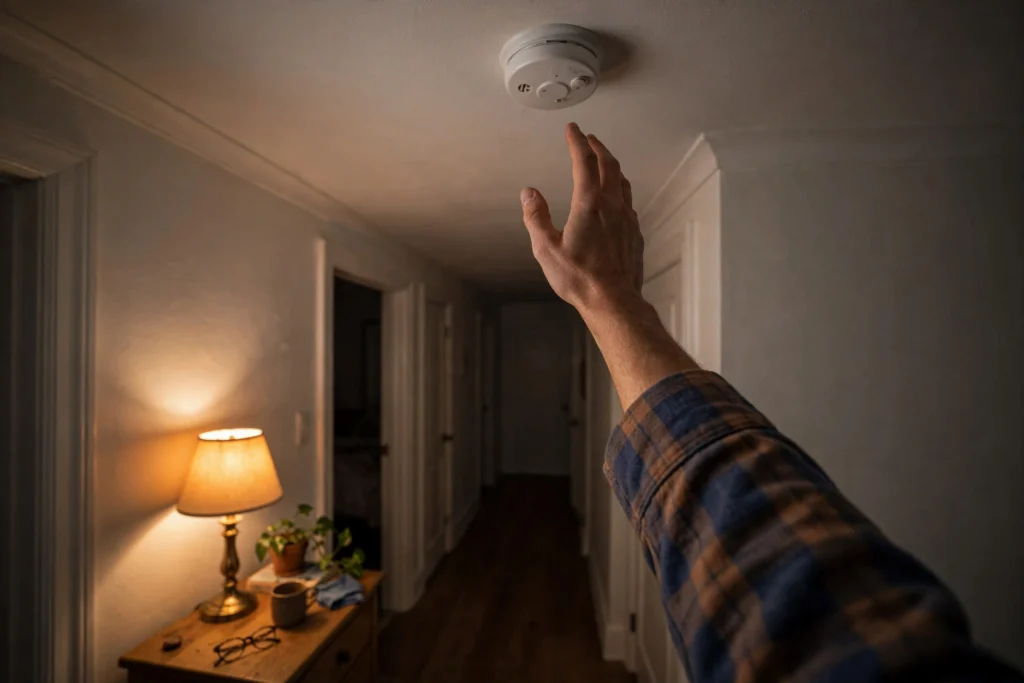
It’s always 3 a.m. A single, piercing chirp every minute or so — just often enough that you can’t fall back asleep, just vague enough that you can’t tell which detector it’s coming from. Congratulations: your smoke detector is trying to tell you something, and it picked the worst possible hour to do it.
Here’s the reassuring part: a chirping smoke detector is almost never broken. It’s sending a specific message, and once you learn to read it, the fix is usually a fresh battery and five minutes of your time. This guide walks through every cause in order of likelihood — and the safety rules that matter when you’re working with hardwired units.
Safety first: Battery-only detectors are completely safe to service. Hardwired detectors (connected to your home’s electrical system) have a backup battery you can change yourself — but turn off the breaker before removing or rewiring the unit itself. Never disable a detector to stop the chirping; a silenced detector protects no one. And if you have to choose between sleep and safety, the chirp wins — fix it properly tonight, not tomorrow.
In This Stop Smoke Detector Chirping Guide
What You’ll Need
- Replacement batteries ($5–10 for a multipack) — check what your detector takes: 9V or AA are the most common. Buy fresh, name-recognizable batteries and check the expiration date; a battery that’s been in a drawer for three years is already half dead.
- Step stool or stable ladder — most detectors are on ceilings. Never stand on a chair with wheels or stack boxes.
- Soft brush, microfiber cloth, or vacuum with brush attachment — for dust cleaning
- A helper (optional but nice) — someone to steady the ladder and hand you things
Chirp vs. Alarm: Know the Difference
Before anything else, make sure you’re hearing a chirp, not an alarm:
- Chirp: a short, single beep every 30–60 seconds. This is a maintenance message — low battery, end of life, or a fault. Annoying, not urgent.
- Alarm: a loud, continuous pattern of 3 beeps, repeating. This means the detector senses smoke or fire. Treat it as real until proven otherwise.
If you’re hearing the full alarm pattern with no smoke present, that’s a different problem (likely a dusty sensor or a unit at end of life giving false alarms) — the cleaning and replacement steps below still apply, but ventilate the area and investigate first.
Cause #1: Low Battery (The Usual Suspect)
⏱ 5 min · 💲 $5–10 · 🛠 Beginner
Roughly nine times out of ten, the chirp means the battery is dying. Detectors chirp at low battery deliberately — and yes, batteries seem to die at 3 a.m. because cooler nighttime temperatures drop the battery’s voltage just enough to trigger the warning.
For battery-only detectors:
- Set up your ladder or step stool on flat, stable ground. Keep three points of contact while climbing.
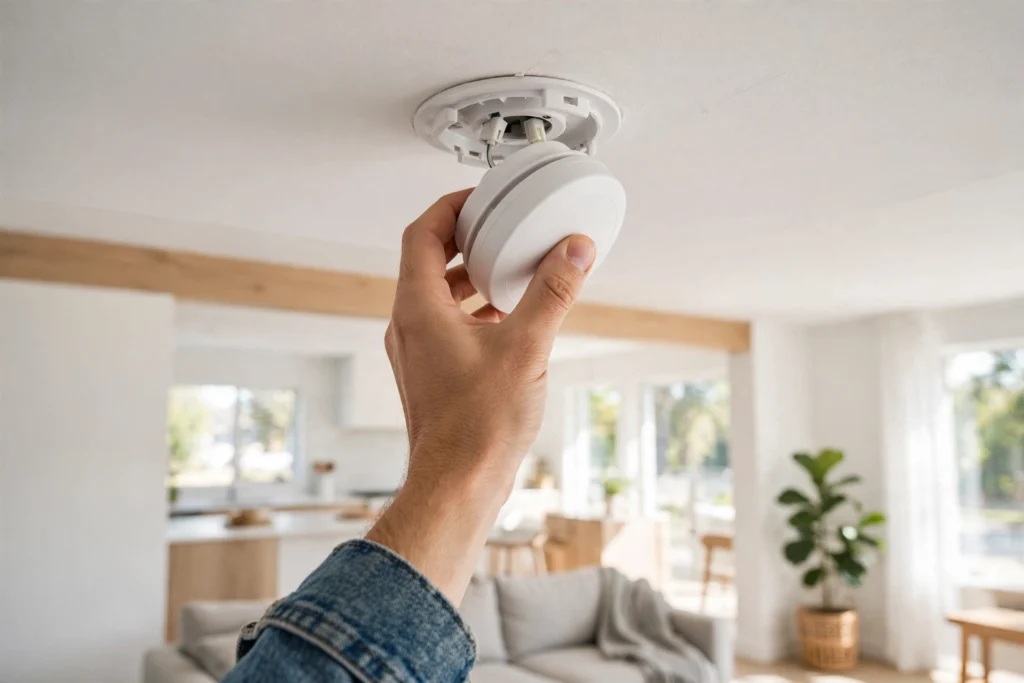
- Twist the detector counterclockwise (most models) to release it from its mounting bracket.
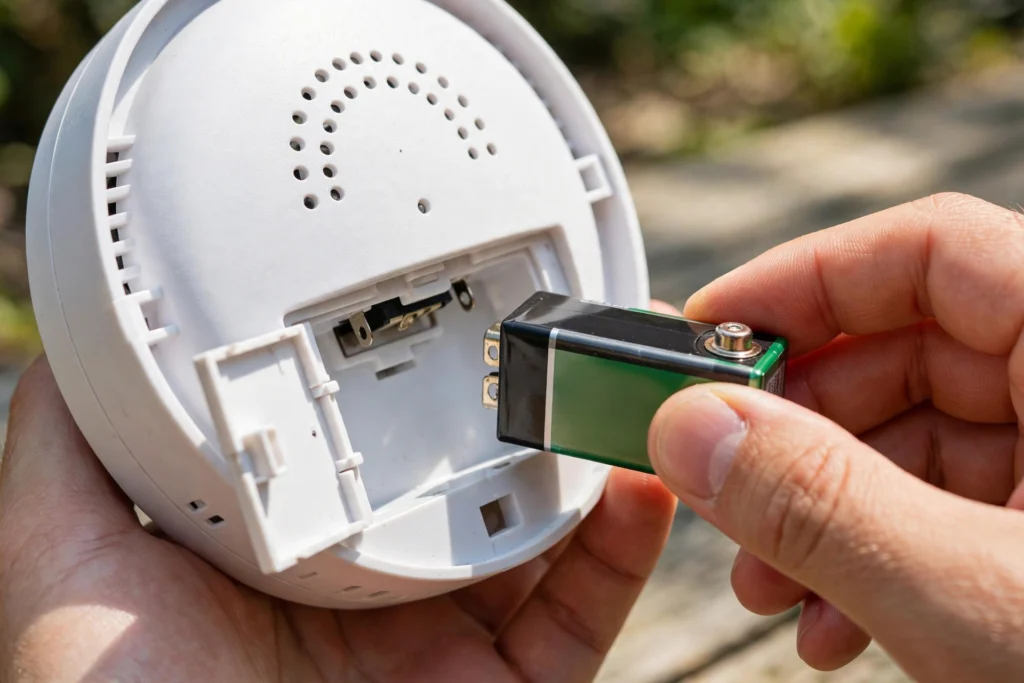
- Open the battery compartment and remove the old battery. Note the type — 9V or AA.
- Press and hold the test button for 15–20 seconds with the battery out. This drains residual charge and clears the low-battery warning from the unit’s memory. Skipping this step is the #1 reason the chirping continues after a battery swap.
- Insert the fresh battery, matching the +/− markings.
- Remount the detector and press the test button once — you should hear the full alarm pattern, confirming it works.
For hardwired detectors (with battery backup):
Hardwired units draw primary power from your home’s electrical system and use the battery only as backup. The battery still dies and still chirps.
- You do NOT need to turn off the breaker just to change the backup battery. Open the battery drawer or compartment (many hardwired models have a slide-out drawer so you don’t even remove the unit).
- Swap the battery, then press and hold the test button for 15–20 seconds to clear the warning.
- If your model requires removing the whole unit to reach the battery, turn off the breaker for that circuit first, then twist the unit off its bracket and unplug the wiring harness. Swap the battery, reconnect, restore power, and test.
Write the date on the new battery with a marker, or set a phone reminder for one year out. Annual battery changes on a date you’ll remember (daylight saving time changes, your birthday) prevent most 3 a.m. chirps.
Call an electrician if: the breaker for the detector circuit trips repeatedly, you see scorched marks or melted plastic on the unit or wiring, or the hardwired unit has no battery drawer and you’re not comfortable turning off the breaker.
Cause #2: Dust and Debris in the Sensor
⏱ 10 min · 💲 $0 · 🛠 Beginner
If a fresh battery doesn’t stop the chirp — or if the unit gives occasional false alarms — dust is the next suspect. Smoke detectors work by sensing particles in the air, and a dusty sensor can’t tell the difference between dust and smoke.
- Remove the detector from its bracket (breaker off first for hardwired units you’re fully removing).
- Vacuum the outside vents and sensor chamber with a soft brush attachment. Be gentle — the sensor is delicate.
- Wipe the exterior with a dry microfiber cloth. Don’t use water, cleaning sprays, or compressed air at close range; moisture and chemicals damage the sensor.
- Remount, restore power if you cut it, and test.
Do this once a year. Detectors in kitchens, near bathrooms, or in dusty workshops need it more often — which brings us to placement.
Cause #3: The Unit Is at End of Life
⏱ 15 min · 💲 $20–40 per unit · 🛠 Beginner
Smoke detectors don’t last forever. Manufacturers recommend replacing them 10 years after the manufacture date — not 10 years after you installed it. The sensing chamber degrades over time, and an expired unit will chirp (many models have a specific end-of-life chirp pattern — check your manual) and eventually false-alarm or fail silently.
How to check:
- Remove the detector and look at the back. You’ll find a manufacture date stamped or printed there.
- If it’s 10+ years old, replace the whole unit — not just the battery. No amount of cleaning revives an expired sensor.
- When buying a replacement, match the type: battery-only replaces battery-only; hardwired replaces hardwired (same wiring harness style if possible — it makes the swap plug-and-play).
A note on the 10-year rule: this is manufacturer guidance based on sensor degradation, and it’s echoed by fire safety organizations. It’s not a law in most places, but it’s the standard every fire professional works to. An 11-year-old detector that “still beeps when tested” can still have a degraded sensor — the test button only checks the horn and battery, not the sensor’s sensitivity.
If one detector in your house is 10 years old, check the others — they were probably installed at the same time.
Cause #4: Humidity, Steam, and Bad Placement
⏱ Varies · 💲 $0 · 🛠 Beginner
Some chirps and false alarms aren’t malfunctions at all — the detector is doing its job, but it’s installed where normal household air looks like smoke:
- Too close to the bathroom: steam from showers drifts out and triggers the sensor. Move the detector at least 10 feet from the bathroom door, or run the exhaust fan during showers.
- Too close to the kitchen: cooking smoke and even toaster steam cause false alarms. Detectors belong outside the kitchen, not in it — 10+ feet from cooking appliances.
- Near a heating vent or in the garage: dust, exhaust fumes, and temperature swings cause trouble. Garages need heat detectors, not smoke detectors.
If your detector false-alarms during every shower or every time you sear a steak, relocation — not replacement — is the fix. And use the hush button (the test button doubles as a hush/silence on most models) for a one-time nuisance alarm rather than yanking the battery. Never remove the battery and forget to put it back — that’s how homes end up unprotected.
Ladder Safety (Because It’s Always the Ceiling)
Most detector maintenance happens overhead, and falls from step stools injure more DIYers than almost any other home task:
- Use a real step stool or ladder on flat ground — not a chair, not a stack of boxes, nothing with wheels.
- Keep your hips between the ladder rails; don’t lean sideways to reach. Move the ladder instead.
- Keep three points of contact (two hands and a foot, or two feet and a hand) while climbing.
- Have someone steady the ladder if you’re going above a step stool’s top steps.
When to Call an Electrician
Battery swaps and cleaning are DIY. Call a licensed electrician when:
- The breaker trips when the detector circuit is on, or trips repeatedly after you reset it.
- You see scorch marks, melted plastic, or a burning smell at the detector or in its wiring box.
- Hardwired detectors lose interconnect — in most modern homes, when one hardwired detector alarms, they all sound. If they used to do this and stopped, the interconnect wiring needs a pro.
- You want to add or relocate hardwired detectors. Running new electrical circuits is not a beginner job.
FAQ
Why does my smoke detector always chirp at night?
Cooler nighttime temperatures slightly reduce a dying battery’s voltage — just enough to cross the low-battery threshold. The battery was already nearly dead; the temperature drop just exposed it. A fresh battery solves it permanently (until next year).
I changed the battery and it still chirps. Now what?
Three things to check in order: (1) Did you hold the test button for 15–20 seconds with the old battery out? Residual charge keeps the warning alive. (2) Is the new battery actually fresh? Check the expiration date — old stock batteries chirp too. (3) Is the unit past its 10-year manufacture date? If so, replace the whole detector.
Can I just take the battery out to stop the chirping?
You can, but you absolutely should not. A detector with no battery is a decoration. Every year, people die in fires in homes where the detector had been disabled “temporarily.” Fix the chirp properly — it’s a 5-minute job.
How often should I replace the batteries?
Once a year for standard batteries, on a date you’ll remember. Some newer detectors come with sealed 10-year lithium batteries — when those die, you replace the entire unit, which conveniently lines up with the 10-year replacement rule.
My hardwired detector chirps even with a new backup battery. What’s wrong?
If the battery is fresh and the warning was cleared (test button held with battery out), the issue is likely the unit itself: end of life (check the manufacture date), a dusty sensor (vacuum it), or a power issue on the circuit (check the breaker). If the unit is under 10 years old, clean, and powered, it may simply be failing — replace it.
The Bottom Line
A chirping smoke detector is a maintenance reminder, not a malfunction: low battery first (with the test-button reset most people skip), dust second, end of life third, bad placement fourth. Work through them in that order and you’ll have silence — and a working detector — in under half an hour.
Detectors are one piece of the home-safety picture. Our new homeowner maintenance guide covers the full monthly and seasonal safety routine — testing detectors, checking the electrical panel, and everything else that keeps a house safe. And if the chirp led you to discover ancient wiring or a dead circuit, our DIY plumbing repairs guide is a good reminder of where the DIY line sits in every trade: know it, respect it, and call a pro past it.